The best license management software depends on the licensing problem you need to solve. Small and growing teams that mainly need SaaS costs, seats, owners and renewal visibility can use a lightweight tracker such as CostLoop. Enterprises managing complex entitlements and publisher audit exposure should look at SAM platforms such as Flexera One, ServiceNow SAM or USU. SaaS-heavy IT teams may need Zluri, Zylo, Torii or CloudEagle, while OpenLM is designed for engineering and floating-license environments.
Short version
If your team mainly needs SaaS costs, seats, owners and renewal visibility, start with a lightweight tracker. If the problem is publisher compliance, entitlement reconciliation or floating engineering licenses, compare specialist SAM, ITAM or engineering-license tools instead.
Scope note: This guide covers buyer-side license management: software used by organizations to manage the applications, subscriptions and licenses they purchase. It does not cover vendor-side licensing platforms used by software publishers to issue license keys, enforce entitlements or monetize their own products.
Key takeaways
- There is no universal #1 license management tool. The right category depends on whether you are managing SaaS seats, enterprise entitlements, IT assets or engineering/floating licenses.
- CostLoop is the lightweight option in this comparison. It fits small and growing teams that want SaaS subscription, seat, owner, cost and renewal visibility without enterprise SAM complexity.
- Flexera One, ServiceNow SAM and USU fit enterprise SAM requirements. They are more appropriate when entitlement reconciliation, publisher-specific licensing, audit readiness and hybrid estates drive the purchase.
- Zluri, Zylo, Torii and CloudEagle fit SaaS-heavy environments that need more automation. Their value is strongest when application discovery, usage signals, reclamation workflows and SaaS governance matter.
- ManageEngine AssetExplorer, AssetSonar and InvGate fit ITAM-led teams. These products connect software-license data with a broader inventory of devices and IT assets.
- OpenLM is a specialist choice for engineering licenses. Concurrent, network and floating-license optimization needs different telemetry from ordinary SaaS seat tracking.
How this comparison was researched
CostLoop publishes this guide and is included in the comparison. The author, Milosh Mladenovski, is CostLoop's founder and therefore has direct product knowledge of CostLoop. Competitor evaluations in this article are research-based unless explicitly stated otherwise; they do not imply hands-on testing.
Every product was assessed against the same decision criteria: primary use case, software and license visibility, discovery/data sources, usage and optimization capabilities, renewal management, enterprise entitlement/compliance depth, ITAM context, engineering-license support, implementation complexity, pricing transparency and current product availability.
Capabilities and pricing were checked primarily against official vendor product pages, documentation and pricing pages on August 16, 2026. Credible independent sources are useful as a secondary validation step, but they are not used here to manufacture a single star score across products that belong to different software categories. The numbers in the list are for navigation, not a universal best-to-worst ranking.
Inclusion criteria
A product made the main shortlist when it met four conditions:
- It is currently available and supported.
- It provides documented buyer-side software, SaaS, ITAM, SAM or engineering-license-management capabilities.
- There is enough current product information to evaluate it responsibly.
- It represents a meaningful buyer use case rather than duplicating another product in the list without adding decision value.
Discontinued products and platforms focused primarily on publisher-side license-key enforcement are excluded.
Best license management software at a glance
| Tool | Best for | Primary category | Discovery / data approach | Public pricing status |
|---|---|---|---|---|
| CostLoop | Small and growing teams | Lightweight SaaS license and subscription tracking | Manual records, CSV, bank-statement import, optional Chrome extension for email scanning/usage monitoring | Free; Pro $9/mo; Business $39/mo |
| Flexera One ITAM | Large enterprises with complex licensing | Enterprise SAM / ITAM | Asset discovery, inventory, third-party integrations, entitlement and contract data | Custom quote |
| ServiceNow SAM | Organizations already using ServiceNow | Enterprise SAM | ServiceNow discovery plus configured third-party and publisher data sources | Custom quote |
| USU Software Asset Management | Enterprise compliance and audit teams | Enterprise SAM | Agent/remote collection, SaaS discovery, entitlement reconciliation | Contact vendor |
| Zluri | SaaS-heavy IT teams | SaaS management | Direct SaaS integrations, identity/data integrations, APIs and other discovery sources | Demo / quote |
| Zylo | Enterprise SaaS-spend teams | SaaS management | App discovery, spend data, direct integrations and usage connections | Quote based |
| Torii | SaaS operations and lifecycle teams | SaaS management | SaaS integrations plus expense, contract and identity/workflow data | Customized pricing |
| CloudEagle.ai | SaaS management and procurement teams | SaaS management / procurement | Direct SaaS integrations, contract/document data and spend-related sources | Demo / quote |
| ManageEngine AssetExplorer | ITAM teams wanting transparent pricing | ITAM + software licenses | Network/asset discovery and software installation data | Cloud from $115/mo for 250 IT assets |
| AssetSonar | Mid-market ITAM/SAM teams | ITAM + SAM | Agent, network/MDM, browser and SaaS/cloud integrations | ITAM $0.75/asset/mo; Advanced SAM +$0.42/asset/mo |
| InvGate Asset Management | ITAM-led organizations | ITAM + software optimization | Software discovery/import, normalization, metering, contracts and asset inventory | Published asset-based tiers |
| OpenLM | Engineering and scientific organizations | Engineering license management | License-server and usage telemetry for engineering/specialty software | Monitoring from $2/user/mo billed annually |
Pricing note: These figures reflect public information checked on August 16, 2026. Enterprise pricing can depend on asset counts, modules, integrations, deployment and services, so the final vendor quote can differ.
Capability fit: what each product is actually designed to manage
| Tool | SaaS seats and renewals | Automated discovery / usage data | Enterprise entitlement / compliance | Hardware ITAM context | Engineering / floating licenses |
|---|---|---|---|---|---|
| CostLoop | Core use case: seats, owners, recurring cost and renewals | Optional import/scanner workflows; not an enterprise discovery platform | Not designed for publisher-specific entitlement reconciliation | No | No |
| Flexera One ITAM | Included within broader ITAM/SAM | Enterprise discovery, inventory and integration ecosystem | Core use case, including entitlement and publisher-license analysis | Yes | Broader software estate; validate specialist engineering requirements |
| ServiceNow SAM | Supported inside SAM workflows | ServiceNow and configured third-party data sources | Core use case: entitlements, reconciliation, reclamation and publisher content | Works with ServiceNow IT workflows/CMDB | Some engineering-server integrations exist; validate specific license managers |
| USU SAM | Supports SaaS alongside traditional software | Automated software/subscription discovery and collection | Core use case: reconciliation, compliance, audit preparation and vendor-specific logic | Part of wider ITAM portfolio | Validate specialist engineering requirements |
| Zluri | Core SaaS use case | Direct integrations and automated SaaS discovery/usage signals | SaaS governance, not traditional enterprise SAM entitlement depth | No hardware-first ITAM focus | No |
| Zylo | Core SaaS use case | App discovery, spend and usage connections | SaaS optimization rather than traditional publisher entitlement reconciliation | No hardware-first ITAM focus | No |
| Torii | Core SaaS use case | SaaS discovery, integrations, usage and workflow data | SaaS governance rather than traditional SAM compliance | No hardware-first ITAM focus | No |
| CloudEagle.ai | Core SaaS use case | Direct integrations plus contract/spend information | SaaS procurement/governance rather than traditional SAM entitlement depth | No hardware-first ITAM focus | No |
| ManageEngine AssetExplorer | Tracks software licenses and expirations | Asset/software discovery and installation data | Compliance-oriented license tracking; not a top-end publisher SAM suite | Core use case | Not a specialist engineering-license platform |
| AssetSonar | SaaS and on-prem software management | Agent/network/MDM/browser/SaaS discovery options | Advanced SAM features for allocation, risk and optimization | Core ITAM context | Not a specialist engineering-license platform |
| InvGate Asset Management | Software contracts, usage and renewals | Discovery/import, normalization and metering | Software-license optimization inside ITAM; validate complex publisher requirements | Core use case | Not a specialist engineering-license platform |
| OpenLM | Not designed around ordinary SaaS subscription ownership | Detailed license-server and usage telemetry | Focused on engineering-license utilization rather than enterprise SAM across all publishers | No general hardware ITAM focus | Core use case |
Which category of license management software do you actually need?
The biggest purchasing mistake is comparing every software license management tool as if the products solve the same problem. They do not.
1. Lightweight SaaS subscription and seat management
Use this category when the problem is operational visibility: what software you pay for, who owns it, how many seats exist, what it costs and when it renews.
Typical requirements:
- purchased and assigned seats
- application owner or department
- monthly and annual cost
- billing cycle
- renewal or expiry date
- duplicate tools
- cancellation details
- invoices, contracts and notes
CostLoop belongs here. It intentionally avoids the complexity of publisher-specific enterprise SAM.
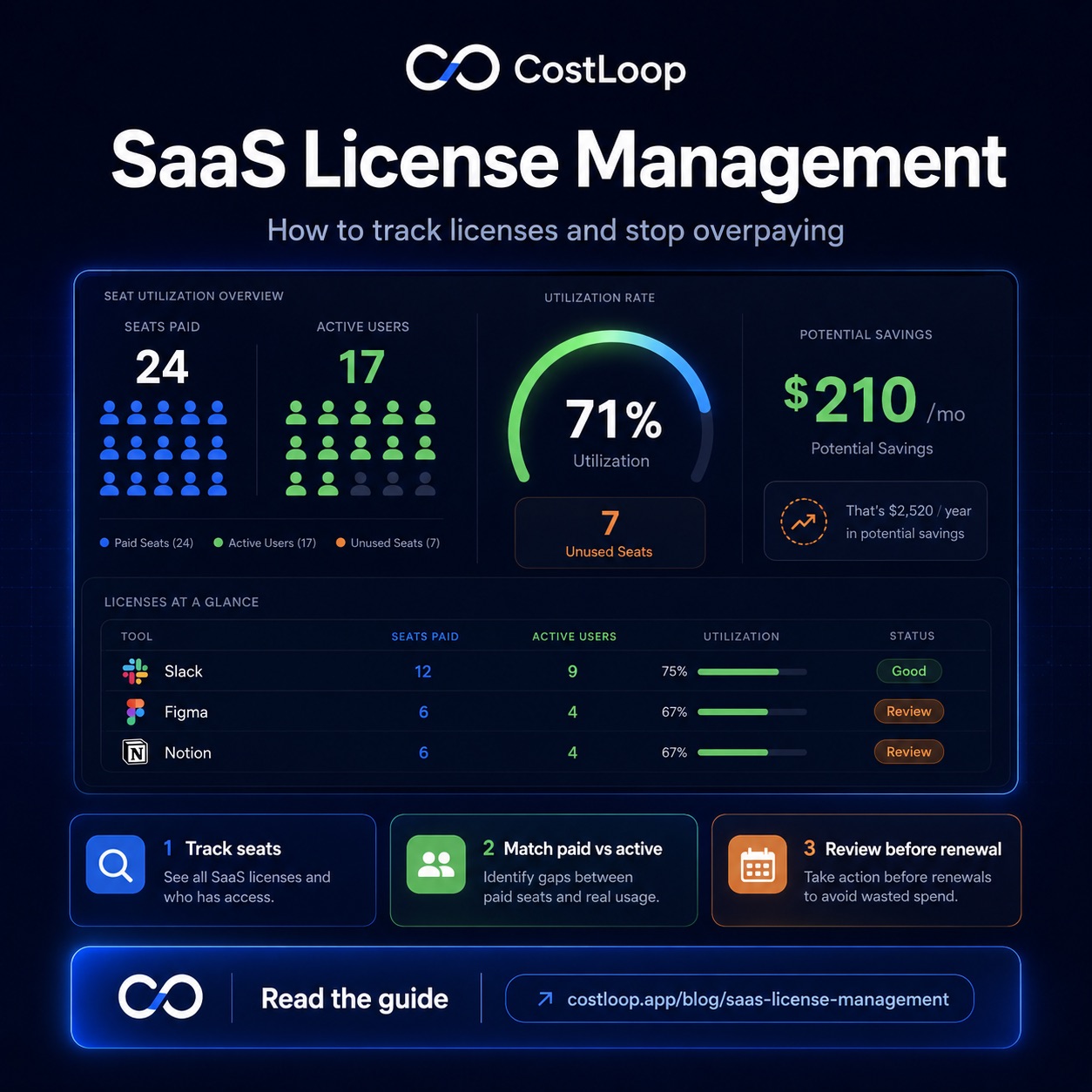
For deeper background, see CostLoop's SaaS license management guide.
2. SaaS management and optimization platforms
Move into this category when a manual inventory is no longer enough and you need automated application discovery, usage signals, identity integrations, license reclamation or SaaS lifecycle workflows.
Zluri, Zylo, Torii and CloudEagle are the main products in this category in our shortlist. BetterCloud is another relevant alternative discussed later.
3. Enterprise Software Asset Management (SAM)
Enterprise SAM is appropriate when the difficult problem is not simply knowing that a subscription exists. It is knowing whether your organization is correctly licensed under complex publisher terms.
Typical requirements include:
- entitlement and contract reconciliation
- publisher-specific licensing rules
- effective license positions
- software audit readiness
- on-prem, SaaS and hybrid estate visibility
- license reharvesting and optimization
- integrations with ITSM, CMDB and procurement workflows
Flexera One ITAM, ServiceNow SAM and USU are designed for this class of problem.
For fundamentals, see CostLoop's software license management guide.
4. ITAM with software-license management
Choose an ITAM-led product when licenses are only one part of the asset picture and you also need devices, installed software, users, contracts and lifecycle information connected.
ManageEngine AssetExplorer, AssetSonar and InvGate fit here. Ivanti Neurons for ITAM is another relevant alternative.
5. Engineering and floating-license management
Engineering, CAD, CAE and scientific applications can use concurrent, network, token, feature-based or floating licenses. These environments require usage telemetry from license servers rather than a simple SaaS seat list.
OpenLM is designed for that specialist use case. Altair Software Asset Optimization is another engineering-focused alternative.
Buyer-side vs vendor-side license management
Buyer-side license management helps an organization manage software it buys and uses. Vendor-side license management helps a software publisher issue license keys, enforce entitlements or monetize software it sells. This comparison covers buyer-side products only.
A practical license-management maturity model
You do not need to buy the most sophisticated platform first. Buy enough capability for the decisions your organization can actually operate.
| Stage | Typical situation | What you need | Best-fit category |
|---|---|---|---|
| 1. Manual control | Small, stable software inventory with one reliable owner | Basic inventory, owner, cost and renewal records | Spreadsheet may still be enough |
| 2. Centralized visibility | Multiple subscriptions, missed renewals or unclear ownership | Central record, seats, owners, recurring spend, reminders, cancellation/document links | Lightweight tracker such as CostLoop |
| 3. Automated SaaS operations | Many apps/users and manual inventory is unreliable | App discovery, usage integrations, reclamation, identity/finance connections, lifecycle workflows | SaaS management platform |
| 4. ITAM / enterprise SAM | Installed software, hardware, entitlements, audits or publisher-specific licensing matter | Discovery, reconciliation, contracts, compliance positions, CMDB/ITSM context | ITAM or enterprise SAM suite |
| Specialist track | Expensive concurrent engineering/scientific licenses | License-server telemetry, utilization, peak demand and harvesting | Engineering license manager |
Moving up this model usually increases capability and implementation effort. Buying enterprise SAM before anyone owns the SAM process does not automatically create a mature license-management function.
2026 market freshness notes
Productiv is no longer an active option
Older comparison articles may still recommend Productiv. Productiv's official website states that the company ceased operations on August 6, 2026, with customer platform access ending on August 5. It is intentionally excluded from this shortlist. Productiv closure notice
This is also a useful procurement lesson: when evaluating any management platform, ask how your inventory, contracts and historical data can be exported if the vendor is acquired, discontinued or you decide to leave.
Snow License Manager and Snow Atlas should not be double-counted
Snow License Manager still exists in customer environments, but Flexera is actively positioning and migrating customers toward the SaaS-based Snow Atlas platform. Because Snow is now part of Flexera's portfolio, this guide does not list Snow as a separate independent competitor to Flexera. Flexera: Snow Atlas upgrade guidance
The 12 best software license management tools in 2026
1. CostLoop: best lightweight option for small and growing SaaS teams
Best for: Startups, agencies, SMBs and lean operations/finance teams that need a clear system for SaaS subscriptions, seats, owners, recurring spend and renewals. Category: Lightweight SaaS license and subscription management.
What CostLoop does particularly well
CostLoop focuses on the operational layer that smaller teams frequently lack: a central record of subscriptions and licenses with cost, billing cycle, owner, renewal date, vendor and supporting information. License records can include seat counts, assigned users and expiry dates. CostLoop also provides renewal views/reminders, spend reporting, duplicate-tool detection, document/cancellation links and an unused-seat signal based on purchased seats versus assigned users. CostLoop features
Discovery and data sources
CostLoop can be maintained manually or through import workflows, including CSV and bank-statement import. The current pricing page also lists a Chrome extension with email-scanning and usage-monitoring capabilities. CostLoop should not be confused with an enterprise discovery platform that continuously reconciles identity, endpoint, procurement and publisher entitlement data. CostLoop pricing
License-management scope
CostLoop is strongest for SaaS subscription visibility, seat assignment, ownership, cost and renewal management. It is not designed for Oracle/SAP/IBM-style publisher entitlement reconciliation, data-center licensing, hardware asset management or engineering license-server telemetry.
Pricing
As verified August 16, 2026:
- Free: $0/month, up to 5 subscriptions
- Pro: $9/month
- Business: $39/month
- Annual billing is advertised with a 17% saving
Pricing can change, so verify the current CostLoop pricing page before purchase.
Advantages
- Low implementation overhead compared with enterprise SAM suites
- Clear fit for costs, owners, seats and renewals
- Public entry-level pricing
- Useful when the current system is a spreadsheet or fragmented records
Limitations
- Not an enterprise SAM entitlement-reconciliation platform
- Not a hardware-first ITAM suite
- Organizations requiring broad automated SaaS discovery across enterprise systems should compare larger SaaS-management platforms
Choose CostLoop when: your main problem is "we do not have a reliable view of the SaaS we pay for, who owns it, how many seats we have and what renews next." Do not choose CostLoop when: your primary requirement is publisher-specific compliance positions, enterprise audit defense, complex data-center licensing or floating engineering-license management.
Source verification: CostLoop Features and Pricing, checked August 16, 2026.
2. Flexera One ITAM: best for complex enterprise software estates
Best for: Large enterprises with complex licensing, hybrid environments and dedicated ITAM/SAM responsibilities. Category: Enterprise SAM / ITAM.
What Flexera does particularly well
Flexera One ITAM combines software asset management, discovery/inventory, contract and entitlement information, license optimization and audit-readiness workflows. Its value is strongest when organizations need to reconcile what is deployed with what they are entitled to use across complex publisher agreements. Flexera One ITAM
Discovery and data sources
Flexera documents asset discovery/inventory capabilities and a broad third-party integration ecosystem. It also incorporates contract and entitlement data rather than relying on application discovery alone.
License-management scope
This is a true enterprise SAM product. Flexera supports publisher and product-use-right analysis, effective license positions and optimization across a complex software estate. Hardware asset-management context and ITSM/CMDB integrations can also be part of the wider platform.
Pricing
Flexera does not publish a simple SMB-style package price for Flexera One ITAM. Buyers should expect a vendor-led scoping and quote process.
Advantages
- Enterprise entitlement and compliance depth
- Strong fit for hybrid estates and complex publishers
- Broad integration and inventory context
- Appropriate for mature SAM programs
Limitations
- Considerably more implementation and governance overhead than a lightweight SaaS tracker
- Pricing requires sales engagement
- Overkill when the problem is only a small SaaS subscription inventory
Choose Flexera when: publisher licensing, entitlements, audit exposure and enterprise-scale optimization justify a formal SAM program. Do not choose Flexera when: you mainly need a lightweight list of subscriptions, seat owners and renewal dates.
Source verification: Flexera One ITAM, checked August 16, 2026.
3. ServiceNow Software Asset Management: best for ServiceNow-centric enterprises
Best for: Enterprises that already operate significant IT workflows, CMDB data and service-management processes in ServiceNow. Category: Enterprise SAM.
What ServiceNow SAM does particularly well
ServiceNow SAM connects software asset-management work to the wider ServiceNow platform. Official documentation covers software models, entitlements, allocations, reconciliation, license reclamation and publisher-specific content/integrations. This makes it particularly relevant when SAM decisions need to connect with existing ServiceNow workflows rather than live in a standalone system. ServiceNow SAM
Discovery and data sources
ServiceNow can use its own discovery capabilities and configured third-party discovery/publisher sources. The exact data architecture depends on the modules and integrations deployed by the organization.
License-management scope
ServiceNow SAM supports entitlements, allocations, reclamation and reconciliation workflows. It is designed for enterprise software governance rather than simple subscription tracking.
Pricing
ServiceNow publishes a pricing-request page rather than a universal numeric SAM price. ServiceNow SAM pricing
Advantages
- Strong ecosystem fit for existing ServiceNow customers
- Connects SAM with ITSM/CMDB and broader workflows
- Enterprise entitlement and reclamation capabilities
- Publisher-specific content is available for supported software estates
Limitations
- Harder to justify if ServiceNow is not already strategic in your environment
- Requires enterprise implementation and governance
- Custom pricing
Choose ServiceNow SAM when: you want SAM to operate inside a broader ServiceNow environment and already have the processes/data to support it. Do not choose it when: you are a small team looking for a standalone subscription and renewal tracker.
Source verification: ServiceNow Software Asset Management, entitlement documentation and pricing, checked August 16, 2026.
4. USU Software Asset Management: best for enterprise compliance and audit readiness
Best for: Enterprises that need software discovery, entitlement reconciliation, vendor-specific licensing logic and audit preparation. Category: Enterprise SAM.
What USU does particularly well
USU documents capabilities for discovering installed software and subscriptions, reconciling usage with entitlements, preparing for audits and applying vendor-specific licensing logic for major publishers. USU Software Asset Management
Discovery and data sources
USU supports agent and remote data collection along with SaaS discovery. It combines discovered usage/deployment data with entitlement information rather than treating application inventory as the final answer.
License-management scope
USU is aimed at complex hybrid environments and enterprise compliance/optimization processes, including license reharvesting and vendor-specific analysis.
Pricing
Standard numeric pricing was not publicly listed on the official product page reviewed; contact USU for current pricing.
Advantages
- Dedicated enterprise SAM depth
- Hybrid software and SaaS coverage
- Vendor-specific licensing logic
- Strong fit for audit-readiness processes
Limitations
- Requires more SAM maturity and operating ownership than a lightweight tracker
- Quote-led purchasing process
- Unnecessary for many SaaS-first SMBs
Choose USU when: audit exposure and complex enterprise licensing justify dedicated SAM tooling. Do not choose it when: your real requirement is simply centralizing recurring SaaS costs, seats and renewals.
Source verification: USU Software Asset Management, checked August 16, 2026.
5. Zluri: best for automated SaaS discovery and license optimization
Best for: SaaS-heavy IT teams that need application discovery, usage signals, license optimization and broader SaaS governance. Category: SaaS management platform.
What Zluri does particularly well
Zluri positions its SaaS Management platform around discovering SaaS and AI applications, building a centralized app inventory, connecting usage/spend/license data and automating actions such as reclamation or downgrade based on usage rules. Zluri SaaS Management
Discovery and data sources
Zluri documents hundreds of direct integrations plus APIs and other integration methods. The practical value is that discovery and usage data can reduce reliance on a manually maintained application inventory.
License-management scope
The platform focuses on SaaS licenses, usage, contracts, renewals and lifecycle/governance. It is not the same thing as traditional enterprise SAM entitlement reconciliation for complex on-prem publishers.
Pricing
The official pages reviewed direct buyers to request a demo/quote rather than providing a simple numeric standard price.
Advantages
- Automated SaaS discovery
- Usage-oriented optimization and reclamation
- Contract and renewal context
- Better fit than a manual tracker when app/user scale increases
Limitations
- More implementation/integration work than a lightweight tracker
- Pricing is not immediately transparent
- Not a replacement for traditional enterprise SAM where publisher entitlements are the core problem
Choose Zluri when: your SaaS inventory is too dynamic to maintain manually and usage-driven license actions matter. Do not choose it when: you only need a simple subscription/renewal record or when complex publisher entitlement reconciliation is the main requirement.
Source verification: Zluri SaaS Management and License & Cost Optimization, checked August 16, 2026.
6. Zylo: best for enterprise SaaS spend and license optimization
Best for: Larger organizations that treat SaaS inventory, utilization, renewal and spend optimization as a formal program. Category: SaaS management platform.
What Zylo does particularly well
Zylo focuses on enterprise SaaS management, including app discovery, spend visibility, usage data, renewals and license-waste identification. Its license-waste functionality is designed to identify inactive or underutilized users/licenses that may be reclaimed, reassigned or downgraded. Zylo license waste
Discovery and data sources
Current Zylo pricing/package information references AI-powered app discovery, spend visibility, usage data connections and direct integrations. Premium/enterprise packages add deeper integrations and automation. Zylo pricing
License-management scope
Zylo is strongest as an enterprise SaaS optimization platform. It is not positioned as a traditional on-prem publisher-entitlement SAM suite or hardware ITAM product.
Pricing
Zylo lists Core, Premium and Enterprise packaging but requires buyers to request pricing.
Advantages
- Enterprise SaaS inventory and optimization focus
- Usage and license-waste workflows
- Renewal and spend context
- Suitable for dedicated SaaS-management programs
Limitations
- Enterprise orientation can be excessive for small teams
- Quote-based pricing
- Not intended to replace complex traditional SAM tooling
Choose Zylo when: SaaS spend and utilization are large enough to justify a dedicated enterprise optimization program. Do not choose it when: your primary requirement is a small, manually manageable SaaS inventory or traditional publisher-compliance analysis.
Source verification: Zylo Pricing and License Waste, checked August 16, 2026.
7. Torii: best for SaaS operations and workflow automation
Best for: IT teams that want SaaS discovery, renewal/license workflows and automation across the application lifecycle. Category: SaaS management platform.
What Torii does particularly well
Torii combines application discovery/visibility with license and renewal workflows, expense/contract integrations, application comparison, forecasting and optimization. Its license optimization approach uses real usage information and policies to support right-sizing. Torii License Optimization
Discovery and data sources
The platform connects SaaS data with integrations and workflow inputs including expense, contract and identity-related processes depending on the deployment.
License-management scope
Torii is primarily about SaaS operations, governance and lifecycle automation rather than full publisher-specific enterprise entitlement reconciliation.
Pricing
Torii states that pricing is customized to the organization's environment. Torii pricing
Advantages
- SaaS discovery and lifecycle automation
- Usage-based license optimization
- Renewal and contract workflows
- Useful for operationalizing repetitive SaaS-management tasks
Limitations
- Custom pricing
- More platform than a small team needs for simple renewal tracking
- Traditional enterprise SAM is not its primary use case
Choose Torii when: you need SaaS operations automation and repeatable lifecycle workflows, not just an inventory. Do not choose it when: you only need a lightweight renewal tracker or deep traditional publisher entitlement management.
Source verification: Torii Pricing and License Optimization, checked August 16, 2026.
8. CloudEagle.ai: best for SaaS management tied closely to procurement and renewals
Best for: SaaS-heavy organizations that want license visibility connected with contracts, renewals, procurement and cost-control workflows. Category: SaaS management / procurement.
What CloudEagle does particularly well
CloudEagle's current product/pricing material describes SaaS Management capabilities including license tracking, contract metadata extraction, renewal-calendar management, license reclamation, duplicate/unused application management and SaaS budgeting. Procurement capabilities extend into intake, buying and renewal workflows. CloudEagle pricing and plans
Discovery and data sources
CloudEagle documents hundreds of direct integrations alongside contract/document and spend-related information. This makes it relevant when procurement and renewal context are as important as the application list itself.
License-management scope
The product is centered on SaaS management, procurement and governance. It is not a traditional enterprise SAM suite for complex publisher entitlements across on-prem data centers.
Pricing
The official page reviewed uses a demo/quote process rather than a simple universal numeric package price.
Advantages
- Connects SaaS inventory with procurement and contract workflows
- License reclamation and renewal management
- Contract/document context
- Appropriate for SaaS purchasing/optimization teams
Limitations
- Broader procurement platform may be more than a small team needs
- Quote-based purchasing
- Not a substitute for enterprise publisher-entitlement SAM
Choose CloudEagle when: SaaS procurement, contracts and renewal operations are tightly connected to your license-management problem. Do not choose it when: you only need a lightweight subscription register or a traditional enterprise SAM compliance platform.
Source verification: CloudEagle Pricing, checked August 16, 2026.
9. ManageEngine AssetExplorer: best ITAM option with straightforward public pricing
Best for: IT teams that want hardware/software asset management and software-license tracking in one product. Category: ITAM + software license management.
What AssetExplorer does particularly well
ManageEngine AssetExplorer tracks software licenses alongside IT assets. Official product information describes purchased-versus-installed visibility, agreements and expiry dates, several license types, and compliant/under-licensed/over-licensed states. AssetExplorer software license tracking
Discovery and data sources
AssetExplorer is built around IT asset and software discovery rather than a purely manual SaaS inventory. Current material also describes monitoring software usage and assigning license information to discovered installations.
License-management scope
This is a good fit when installed software and hardware asset records belong in the same system. It provides practical license/compliance tracking, but buyers with highly complex publisher-specific licensing should validate whether they need a more specialized enterprise SAM suite.
Pricing
As verified August 16, 2026, ManageEngine lists the cloud edition from $115/month for 250 IT assets. Higher asset tiers and annual/on-premises options are also published. AssetExplorer pricing
Advantages
- Hardware and software inventory together
- Public pricing makes initial budgeting easier
- Practical software-license compliance states
- Suitable for ITAM-led teams
Limitations
- Less streamlined than a SaaS-only tracker if hardware/installed software are irrelevant
- Validate complex publisher-entitlement requirements before treating it as a replacement for top-end SAM
Choose AssetExplorer when: your license records need to live with the wider IT asset inventory. Do not choose it when: you only care about a small set of recurring SaaS subscriptions and want minimal operational overhead.
Source verification: ManageEngine Software License Tracking and Pricing, checked August 16, 2026.
10. AssetSonar: best for combining ITAM with SaaS and on-prem software management
Best for: Mid-market IT teams that want IT asset management plus more advanced software discovery, allocation and optimization. Category: ITAM + SAM.
What AssetSonar does particularly well
AssetSonar's current Advanced SAM offering includes software discovery/tracking, browser plugins, a unified software catalog, license allocation/tracking, SaaS/cloud integrations, compliance/risk monitoring, optimization/reclamation and renewal notifications. AssetSonar pricing
Discovery and data sources
The platform documents agent-based, network and MDM discovery. Advanced SAM adds browser and SaaS/cloud discovery/integration capabilities.
License-management scope
AssetSonar covers both SaaS and on-prem software in an ITAM context, making it relevant when the organization wants software licensing and broader device/asset records together.
Pricing
The official pricing page checked August 16, 2026 lists:
- ITAM: $0.75 per asset/month
- Advanced SAM add-on: $0.42 per asset/month
Minimums and final configuration requirements should be confirmed with the vendor.
Advantages
- ITAM and software-license management in one platform
- Multiple discovery methods
- SaaS and on-prem software coverage
- Public per-asset pricing
Limitations
- Per-asset model can be unnecessary for a very small SaaS-only inventory
- Not positioned as a specialist engineering-license manager
- Organizations with extremely complex publisher entitlement requirements should validate fit carefully
Choose AssetSonar when: you need a broader ITAM system with meaningful software discovery and SAM features. Do not choose it when: your only requirement is a small SaaS renewal/seat register.
Source verification: AssetSonar Pricing, checked August 16, 2026.
11. InvGate Asset Management: best for ITAM-led software visibility and metering
Best for: IT teams that want asset inventory, software normalization, usage metering, contracts and renewal context in one ITAM workflow. Category: ITAM + software optimization.
What InvGate does particularly well
InvGate documents software discovery/import, normalization, usage metering, purchased-versus-used analysis, contract records, renewal timing and reporting. The value is the connection between software data and the broader IT asset inventory. InvGate software license optimization
Discovery and data sources
The platform can discover/import installed software and normalize that data before usage and license analysis. This is more ITAM-oriented than a lightweight SaaS subscription register.
License-management scope
InvGate helps teams understand software inventory, metering, contracts and utilization. Organizations with complex publisher-specific entitlement requirements should validate the exact licensing coverage against their estate before choosing it over a specialist enterprise SAM platform.
Pricing
InvGate's vendor-published 2026 software license tracking guide lists Asset Management tiers beginning at $1,499/year for 500 IP devices for Starter, $2,500/year for Professional at that starting scale, and $12,000/year for Enterprise. Treat these as vendor-published reference prices and confirm the current quote. InvGate pricing reference
Advantages
- IT asset and software inventory together
- Software normalization and metering
- Contract and renewal context
- Published reference pricing is more transparent than many enterprise vendors
Limitations
- More ITAM infrastructure than a SaaS-only small business may need
- Complex publisher entitlement requirements require validation
Choose InvGate when: ITAM is the operating model and software visibility/metering should be part of it. Do not choose it when: you want the smallest possible tool for SaaS ownership, cost and renewals.
Source verification: InvGate Software License Optimization and vendor-published Software License Tracking guide, checked August 16, 2026.
12. OpenLM: best for engineering, concurrent and floating licenses
Best for: Engineering, manufacturing, architecture, research and scientific organizations running expensive specialist software through license servers or concurrent-license models. Category: Engineering license management.
What OpenLM does particularly well
OpenLM is designed around the telemetry that engineering-license buyers actually need: utilization, trends, idle sessions, concurrency and license harvesting. It supports a range of engineering/specialty license models rather than treating every product as a named SaaS seat. OpenLM Software License Management
Discovery and data sources
OpenLM collects information from license managers/servers and engineering application environments. It can be deployed in cloud or on-premises configurations depending on the product setup.
License-management scope
This is a specialist engineering-license product. Its job is not to provide a general hardware ITAM inventory or replace enterprise SAM across every publisher.
Pricing
The current official product page lists:
- Monitoring: $2/user/month, billed annually
- Automation: $3/user/month, billed annually, adding automation/harvesting capabilities
Verify the exact product/module requirements with OpenLM before purchase.
Advantages
- Purpose-built for expensive engineering license environments
- Detailed utilization and concurrency visibility
- Idle-license harvesting/automation options
- Cloud and on-premises deployment options
Limitations
- Unnecessary for ordinary SaaS subscription tracking
- Not a general hardware ITAM platform
- Not intended to replace enterprise SAM across all software publishers
Choose OpenLM when: concurrency, peak usage and engineering license-server utilization determine how many expensive licenses you need. Do not choose it when: your problem is simply SaaS seats, owners, costs and renewal dates.
Source verification: OpenLM Software License Management, checked August 16, 2026.
Other license-management tools worth considering
A useful shortlist should not pretend the 12 products above are the only credible options. These alternatives deserve consideration, but adding full reviews would make the primary comparison less focused.
BetterCloud
What it specializes in: SaaS operations, governance, lifecycle automation and license/spend optimization. BetterCloud documents capabilities around license reclamation, vendors/contracts/renewals, shadow IT and employee onboarding/offboarding. BetterCloud SaaS spend optimization
Why it is not in the main 12: The shortlist already includes four full SaaS-management platforms, and BetterCloud's broader SaaS-operations/security orientation would duplicate that category more than it would add a new buyer type.
Who should still consider it: Organizations where SaaS lifecycle automation, governance and security workflows matter alongside license optimization.
Ivanti Neurons for ITAM
What it specializes in: A broader IT asset system of record covering hardware and software lifecycle information, with discovery and CMDB/ITSM context. Ivanti Neurons for ITAM
Why it is not in the main 12: ManageEngine, AssetSonar and InvGate already represent the ITAM-led buying path in the primary shortlist.
Who should still consider it: Organizations already invested in the Ivanti ecosystem or looking for license information inside a broader ITAM/ITSM operating model.
License Dashboard
What it specializes in: Software Asset Management technology and services focused on license compliance, audit readiness and cost optimization. License Dashboard
Why it is not in the main 12: The main shortlist already contains three large enterprise SAM platforms. License Dashboard is still relevant, especially for organizations that value a specialist SAM/service-led approach.
Who should still consider it: Teams that want focused SAM expertise and audit/compliance support rather than a broader SaaS-management platform.
Altair Software Asset Optimization
What it specializes in: Engineering/CAD/CAE software utilization and optimization. Altair Software Asset Optimization
Why it is not in the main 12: OpenLM occupies the primary engineering-license slot in this comparison, and adding multiple full specialist reviews would distort a broad market guide.
Who should still consider it: Engineering organizations already using Altair or those comparing specialist license-utilization analytics for high-value technical software.
How to choose: a six-question decision path
1. Are you mainly tracking SaaS subscriptions, seats, owners and renewals?
If yes, start with a lightweight license/subscription tracker. You may not need enterprise discovery or SAM. CostLoop fits this use case.
If no, continue.
2. Is manual SaaS inventory unreliable because you have many apps, users or identity/expense systems?
If yes, shortlist SaaS management platforms such as Zluri, Zylo, Torii, CloudEagle or BetterCloud. The key requirement becomes discovery and usage data, not simply record keeping.
3. Do you manage complex publisher entitlements or software audit exposure?
If yes, shortlist enterprise SAM products such as Flexera One, ServiceNow SAM, USU or a specialist such as License Dashboard. You need entitlement/reconciliation capability, not just SaaS discovery.
4. Do hardware and software assets need to live in the same system?
If yes, look at ITAM-led products such as ManageEngine AssetExplorer, AssetSonar, InvGate or Ivanti Neurons for ITAM.
5. Do you manage floating or concurrent engineering licenses?
If yes, evaluate specialist products such as OpenLM or Altair Software Asset Optimization. Peak concurrency and license-server utilization are more relevant than simple assigned-seat counts.
6. Can your organization support the implementation complexity?
A feature has no value if you cannot feed it reliable data, assign an owner or act on the findings. Before buying a more sophisticated platform, identify:
- who owns the license-management process
- which systems must be integrated
- how often data must be reconciled
- who approves reclamation or renewal decisions
- how contracts and entitlements will be maintained
- whether the organization can support agents, identity integrations or CMDB/ITSM dependencies
The best license-management system is the smallest system that fully solves your current risk without leaving a critical compliance gap.
What smaller teams probably do not need to pay for
If you have a few dozen mostly SaaS applications and your real problem is visibility, seats, costs and renewals, you probably do not need to buy enterprise functionality simply because it sounds sophisticated.
You may not need:
- Oracle/SAP/IBM-style publisher-specific entitlement engines
- data-center and virtualization license modeling
- automated enterprise audit-position calculations
- endpoint software metering across thousands of devices
- a full CMDB integration program
- engineering license-server telemetry
- specialist SAM implementation consulting
- complex multi-business-unit chargeback workflows
Those capabilities solve real problems for organizations that have them. They become wasted cost and operational overhead when the actual problem is: "We do not know which SaaS subscriptions we pay for or what renews next month."
Conversely, a small business should not underbuy if it genuinely faces publisher audit exposure or complex licensing. Simplicity is useful only when it still covers the real risk.
How to calculate potential unused-license cost
A simple formula helps turn license hygiene into a financial decision:
Potential annual avoidable license cost = (paid seats - seats genuinely needed) x monthly price per seat x 12
Hypothetical example
Assume a team has:
- 40 paid seats
- 31 seats genuinely required
- $18 per seat per month
Unused capacity:
40 - 31 = 9 seats
Potential monthly avoidable cost:
9 x $18 = $162
Potential annual avoidable cost:
$162 x 12 = $1,944
Seat utilization in this example:
31 / 40 = 77.5%
This is a hypothetical calculation, not an industry benchmark. The important step is to validate whether seats are genuinely unnecessary before removing them. A user who logs in infrequently may still require the software for a critical monthly or quarterly task.
For more practical guidance, see CostLoop's guide to unused software seats.
What should a license management tool track?
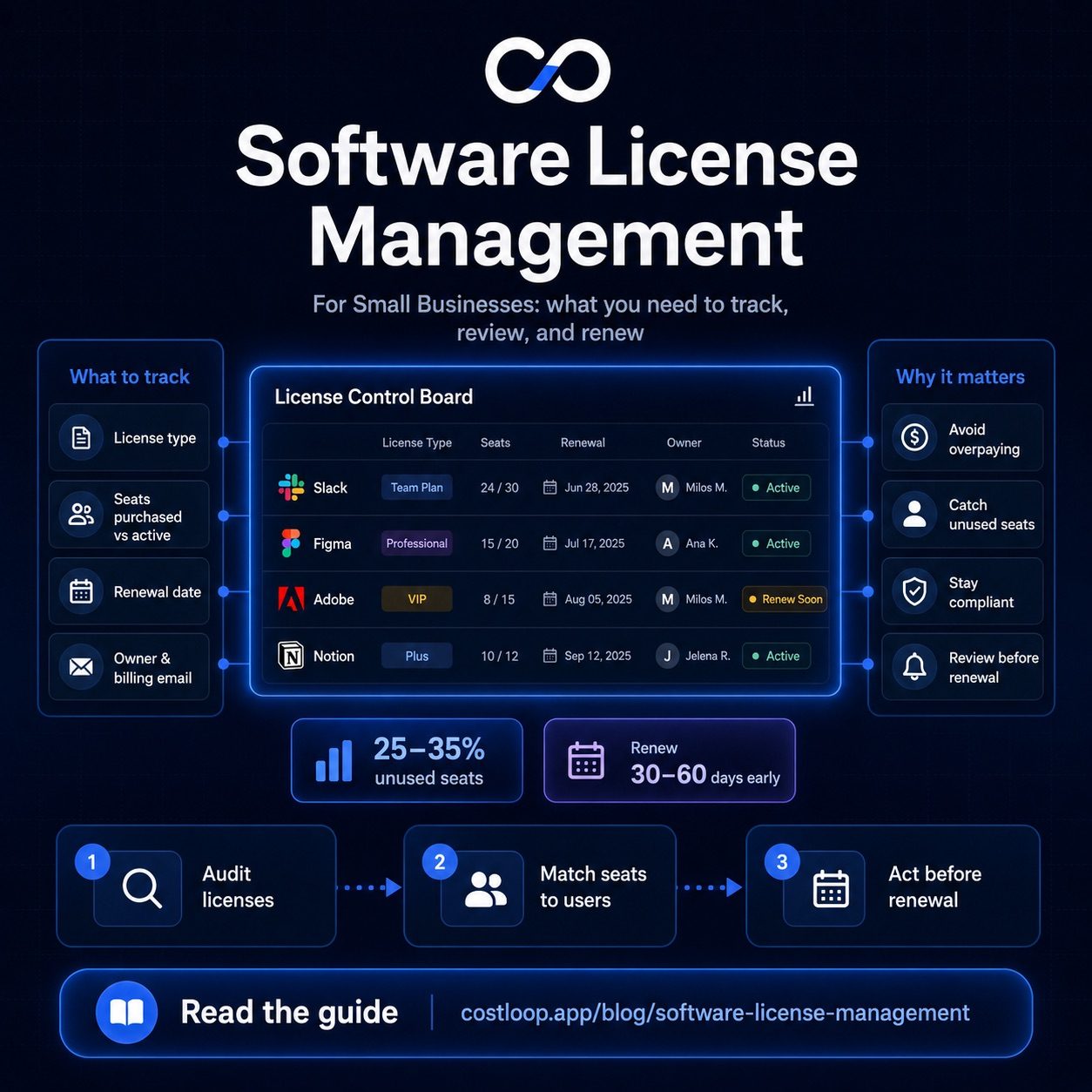
At minimum, a buyer-side license-management system should maintain enough information to support an ownership, renewal and cost decision:
- software/vendor name
- subscription or license type
- owner and department
- purchased seats or entitlements
- assigned users where relevant
- monthly/annual cost
- billing cycle
- renewal or expiry date
- cancellation/notice requirements
- contract, invoice or document links
- status and notes
More advanced platforms add:
- automated application discovery
- application usage data
- identity and finance integrations
- software installation data
- entitlement reconciliation
- publisher-specific license logic
- reclamation automation
- contract and procurement workflows
- audit/compliance reporting
Do not buy advanced fields and dashboards unless you have reliable data sources and a process that will act on them.
Questions to ask during a license-management vendor demo
A good demo should prove how the product turns raw data into a licensing decision. Ask these questions rather than accepting a generic dashboard tour.
- Exactly how do you discover software? Ask which sources are used: SSO/identity, endpoint agents, finance/expense systems, browser activity, direct SaaS integrations, email, APIs, license servers or manual imports.
- What happens when an application has no direct integration? Ask whether the platform can still discover it and what data becomes unavailable.
- Can you distinguish purchased seats, assigned seats and active users? These are different concepts and should not be presented as interchangeable.
- How do you define an unused license? Ask what time window, activity signal or business rule is used and whether exceptions can be configured.
- Which publishers have specialized entitlement or licensing logic? This matters if you are evaluating enterprise SAM rather than SaaS management.
- How are renewal dates discovered and validated? Ask whether dates come from contracts, integrations, email, manual entry or procurement data, and how conflicts are resolved.
- Can we export all of our data if we leave? Ask about inventory, contracts, historical usage, documents and audit trails, not only a basic CSV of app names.
- What implementation resources do you require from our team? Ask about agents, API permissions, SSO, finance integrations, CMDB work, data normalization and ongoing administration.
- Which capabilities cost extra? Ask specifically about discovery connectors, publisher packs, advanced SAM, procurement modules, implementation services and API access.
- Show us one real workflow from finding an unused license to making a renewal decision. A platform should demonstrate the evidence, owner, approval and resulting action rather than only showing analytics.
How CostLoop fits, and when you should graduate to something larger
CostLoop's strongest position is straightforward: small and growing teams that mainly need SaaS subscription visibility, seat counts, owners, recurring costs and renewal control without enterprise SAM complexity.
A practical CostLoop workflow is:
- Add or import the software subscriptions the organization pays for.
- Record cost, billing cycle, owner, vendor and renewal date.
- Add license/seat information and assigned users where relevant.
- Review purchased versus assigned capacity.
- Check upcoming renewals before the business is committed again.
- Flag duplicate tools or unnecessary capacity for review.
- Keep cancellation links, invoices, contracts and notes with the subscription record.
See the current CostLoop feature list and pricing for the exact plan capabilities.
When CostLoop is enough
CostLoop is a sensible fit when:
- the software estate is mostly SaaS
- the primary risk is forgotten renewals, unclear ownership or seat waste
- the team wants a central source of truth without a long ITAM/SAM implementation
- manual/import-assisted management is acceptable
- enterprise publisher entitlement reconciliation is not required
When to move to a more sophisticated platform
Graduate to a broader SaaS-management platform when automated application discovery, usage telemetry and identity/finance integrations become essential.
Move to ITAM when hardware and installed software must be managed in the same lifecycle.
Move to enterprise SAM when contract entitlements, publisher-specific licensing and software audits create material financial/compliance risk.
Move to an engineering-license manager when concurrent/floating utilization determines how many expensive technical licenses you need.
That boundary is important. CostLoop should not be bought to solve a problem that requires Flexera, ServiceNow, USU, OpenLM or a comparable specialist platform.
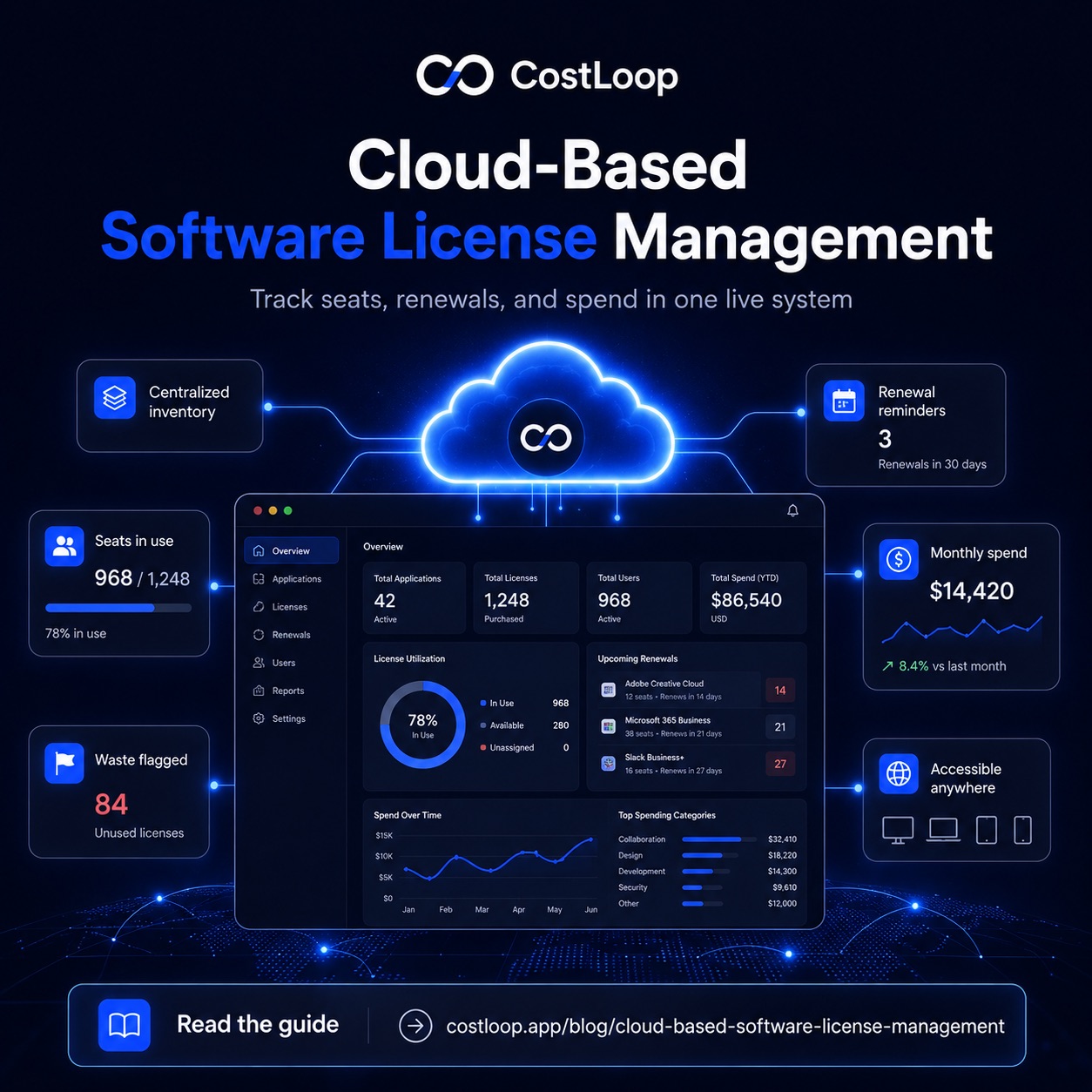
For related workflows, see how to track software subscriptions, cloud-based software license management and the small-business SaaS audit guide.
Frequently asked questions
What is license management software?
License management software helps an organization track, control and optimize the software licenses or subscriptions it purchases. Depending on the product category, it can manage seats, owners, costs and renewals, discover applications and usage, reconcile contractual entitlements, connect licenses with IT assets or monitor engineering license servers.
This guide covers buyer-side license management, not license-key systems used by software vendors to license their own products.
What is the best license management software in 2026?
There is no single best product for every company. CostLoop fits lightweight SaaS tracking for smaller teams; Zluri, Zylo, Torii and CloudEagle fit more automated SaaS management; Flexera One, ServiceNow SAM and USU fit complex enterprise SAM; ManageEngine, AssetSonar and InvGate fit ITAM-led use cases; and OpenLM fits engineering/floating licenses.
Choose the category first, then compare vendors inside that category.
What is the best license management software for a small business?
For a small business whose main problem is SaaS costs, seats, owners and renewals, a lightweight tool is usually more appropriate than enterprise SAM. CostLoop is designed for that use case and has public entry-level pricing.
A small business that already needs automated discovery across many identity/finance systems may instead justify a larger SaaS-management platform. A small company with complex publisher audit risk may still need specialist SAM despite its size.
What is the difference between SaaS management, SAM and ITAM?
SaaS management focuses on cloud applications, licenses, usage, spend and lifecycle workflows. Software Asset Management (SAM) focuses more deeply on software entitlements, licensing rights, compliance and optimization. IT Asset Management (ITAM) is broader and covers the lifecycle of technology assets, often including hardware and software together.
The categories overlap, but the difficult decision each system is built to support is different.
How much does license management software cost?
Pricing ranges from free/lightweight plans to custom-priced enterprise platforms. At the time of verification, CostLoop had a free plan and paid plans from $9/month; ManageEngine AssetExplorer published cloud pricing from $115/month for 250 IT assets; AssetSonar published per-asset ITAM/SAM pricing; and many enterprise/SaaS-management vendors required a quote.
Compare total cost, including implementation, integrations and ongoing administration, not only the software subscription.
When do you need enterprise SAM?
You need enterprise SAM when publisher entitlements, contract terms, effective license positions, software audits or complex hybrid deployments create material risk. If the hardest question is "Are we licensed correctly under this publisher agreement?" a SaaS renewal tracker is not enough.
If the hardest question is merely "What renews next month and who owns it?" enterprise SAM may be unnecessary.
When is a spreadsheet enough for software licenses?
A spreadsheet can be enough when the software inventory is small, changes infrequently and has one reliable owner. It begins to fail when multiple people maintain the data, renewal dates are missed, assigned-seat information becomes stale, supporting documents are scattered or nobody trusts the inventory.
The point to upgrade is not a fixed number of applications. It is the point where unreliable information starts creating cost, renewal or compliance risk.
How do you calculate unused-license cost?
A simple estimate is: (paid seats - seats genuinely needed) x monthly price per seat x 12. For example, nine unnecessary $18/month seats represent $1,944 of potential annual avoidable cost.
Validate real business need and usage before reclaiming licenses; infrequent usage does not automatically mean a license is unnecessary.
Final recommendation
Do not choose license-management software by counting features. Choose it by identifying the most expensive or risky decision you cannot make reliably today.
If that decision is about SaaS owners, seats, recurring spend and renewals, start lightweight. If manual inventory is unreliable, move to SaaS discovery and optimization. If hardware and installed software must be managed together, choose ITAM. If publisher entitlements and audits drive the risk, choose enterprise SAM. If concurrent engineering licenses drive spend, use a specialist engineering license manager.
For small and growing SaaS-heavy teams, CostLoop provides a simpler starting point without pretending to replace enterprise SAM. For more complex environments, this guide should help you shortlist the category and vendor that actually matches the problem.
Ready to get SaaS licenses, renewals and recurring software costs out of spreadsheets? Review CostLoop's features or compare the current plans.
Ready to get SaaS licenses under control?
CostLoop helps small teams track SaaS subscriptions, seats, owners, renewals, invoices and recurring software costs without enterprise SAM complexity.
Start free