Last verified: July 29, 2026
Quick answer
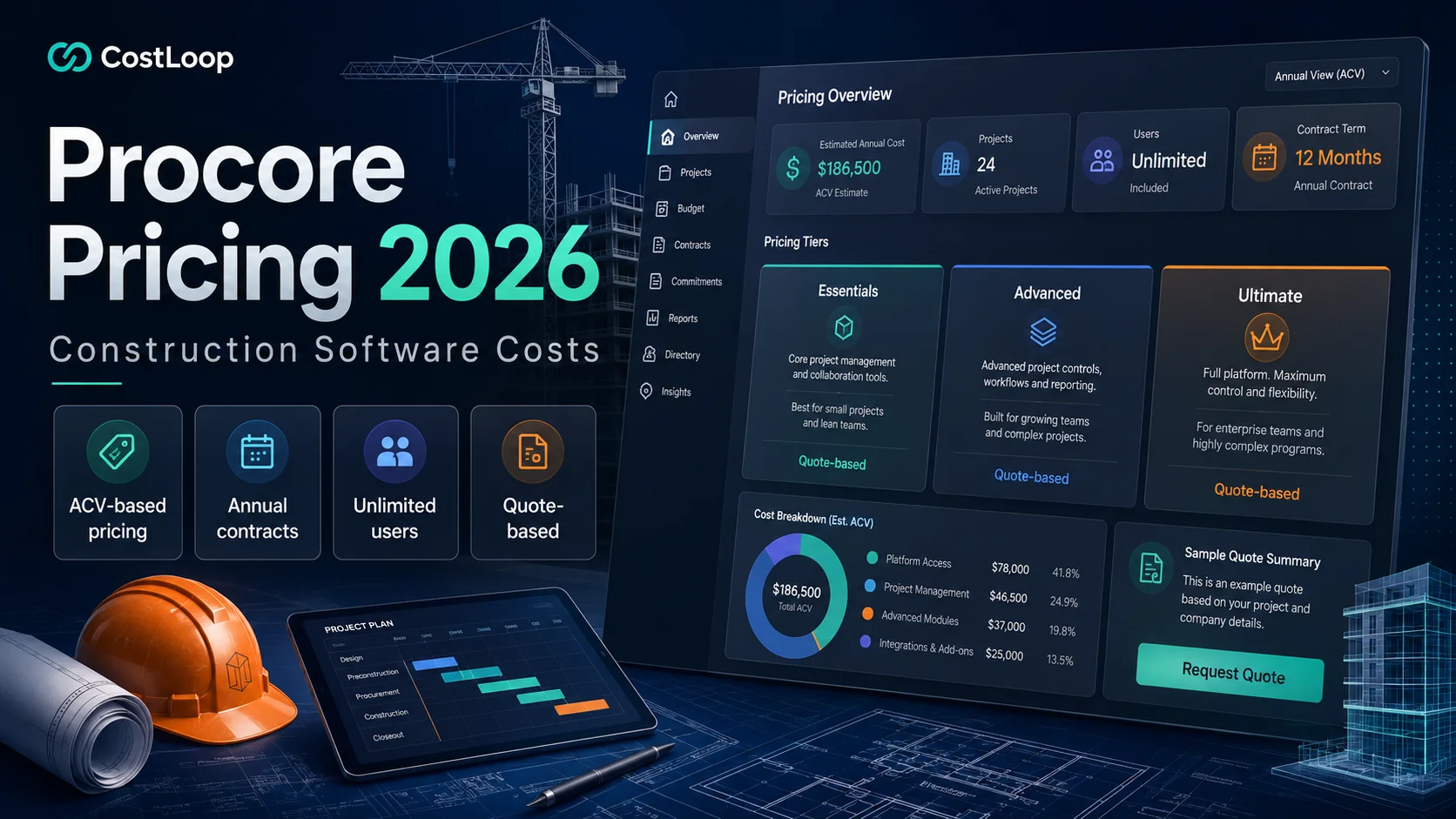
If you are searching procore construction software cost, the most important thing to know is that Procore does not publish one universal list price or a normal per-user SaaS rate.
According to Procore's current U.S. pricing page, your annual contract price depends primarily on:
- Which Procore products you buy, and
- Your Annual Construction Volume (ACV) - the total dollar value of construction work run through Procore.
Procore prices the contract up front for the year and includes unlimited users, unlimited data/storage, 24/7 support, training, and product enhancements. The exception Procore calls out is Field Productivity, which is priced based on FTE rather than the standard ACV model.
So if you want an exact cost of Procore software, the honest answer is: you need a custom quote. Any article giving one flat 2026 Procore price without knowing your product bundle and construction volume is guessing.
In this guide
- How Procore pricing works in 2026
- Why Procore does not use normal per-seat pricing
- What drives procore construction management software cost
- How to estimate your Procore budget before talking to sales
- Which product areas can increase your quote
- What is included in the annual contract
- How multi-year pools, volume opt-in, and renewal rate protection work
- How to compare Procore cost with per-user construction software
- How to track Procore contracts and renewals after purchase
Methodology and disclosure
This guide is based on Procore's current U.S. pricing page, Procore's product catalogue, and Procore's published explanation of its ACV pricing model and deal structures, reviewed in September 2026.
Where Procore publishes a concrete pricing rule, this article uses it. Where Procore requires a custom quote, this article says so rather than inventing a dollar amount.
CostLoop publishes this guide and operates in subscription, software-cost, and renewal tracking. CostLoop is not construction management software and does not replace Procore. The overlap is commercial control: keeping a major annual software contract, its owner, renewal date, documents, and recurring cost visible once your company has purchased it.
For broader cost-control workflows, see CostLoop's project management subscription tracker, software budget template, renewal tracker guide, and software license lifecycle management guide.
Related CostLoop guides
- Aconex Pricing 2026
- Project Management Subscription Tracker
- Software Budget Template
- Renewal Tracker for Software Subscriptions
- Software License Lifecycle Management
- Software License Inventory
- Cloud-Based Software License Management
- 12 Best License Management Software Tools in 2026
- CostLoop Features
- CostLoop Pricing
How Procore pricing works in 2026
The biggest mistake buyers make is assuming procore software price works like Asana, Monday.com, or Jira.
It does not.
Most SaaS tools follow a simple model: users x monthly seat price = subscription cost
Procore's core model is different: selected products + Annual Construction Volume = annual Procore quote
Procore defines Annual Construction Volume as the aggregate dollar value of the construction work across your projects.
That means a company managing $25 million of annual construction and a company managing $500 million of annual construction should not expect the same quote even if both have 100 employees.
Why Procore uses ACV instead of seats
Procore's model is designed to let construction companies invite the people needed to collaborate without paying a new software seat fee every time another stakeholder joins the project.
The current pricing page includes: unlimited users, unlimited data and document storage, unlimited 24/7 support, free training, ongoing product enhancements.
For owners, Procore also explicitly says contractors can be invited without additional seat charges.
This is why procore construction software price should be compared with the value and scale of the construction program, not only the number of internal employees.
Is there a published Procore software cost?
No universal dollar figure is currently published on Procore's U.S. pricing page.
The site asks buyers to provide company type and business requirements to receive a custom quote.
This applies whether you search: procore software cost, procore software price, cost of procore software, procore construction software cost, procore construction software price, or procore construction management software cost.
The responsible answer is the same: the quote varies by product selection and construction volume.
That is less convenient than a public price table, but it is better than publishing a fake number that may be completely wrong for your company.
What drives Procore construction management software cost?
There are five major cost drivers to understand before requesting pricing.
1. Annual Construction Volume
ACV is the central pricing metric for most Procore contracts.
If your organization expects to run more construction through Procore, the contract can increase because the economic scope of the platform is larger.
But Procore also says total software cost does not necessarily grow at the same rate as construction volume. Its published ACV explanation describes a volume-discount effect as customers scale.
The budget number you need before calling sales
Before requesting a quote, calculate: Expected ACV = total value of all construction work expected to run through Procore during the contract period
Do not use company revenue unless it truly matches the construction work Procore will cover.
For example, if your company expects to run: Project A: $12 million, Project B: $18 million, Project C: $30 million, then the initial ACV assumption is: $12M + $18M + $30M = $60M ACV
That does not tell you the Procore price. It tells you the primary scale metric the vendor will use to build the quote.
2. Which Procore products you select
Procore lets buyers choose from a suite of products and capabilities rather than forcing every organization into one identical bundle.
Its current product catalogue includes areas such as: Project Execution, Cost Management, Resource Management, Project Lifecycle Management, Project Management, Project Financials, Bid Management, Estimating, Schedule, Quality & Safety, BIM, Invoice Management, Resource Planning, Equipment, Pay, Analytics and Insights.
The more product areas your company needs, the more important it becomes to ask for a line-item explanation of the quote.
Practical buying rule
Do not tell sales: "We want Procore."
Tell sales: "These are the workflows we need to replace, these are the products we believe cover them, and these are the workflows we do not want included."
That gives procurement something concrete to negotiate.
3. Company type and deployment scope
Procore's pricing flow asks whether you are a: General Contractor, Specialty Contractor, Owner / Developer, or Government organization.
That matters because different company types use different parts of the platform and can have different commercial structures.
A general contractor may care heavily about project execution and financial workflows. An owner may be focused on portfolio oversight and capital project delivery. A specialty contractor may need different field and resource capabilities.
The phrase procore construction management software cost therefore hides an important question: cost for which type of construction business?
4. Field Productivity FTE pricing
Procore specifically notes that its standard pricing model excludes the Field Productivity product, which is priced based on FTE.
That means you should ask whether any part of your planned bundle uses an FTE-based metric instead of ACV.
If you skip that question, your internal cost model can be wrong even when your ACV assumption is correct.
5. Contract structure and renewal terms
Procore has published several deal structures designed to make ACV-based pricing more predictable:
Multi-year pools: Instead of forcing the same construction volume into each year, contract volume can be pooled across the full multi-year term and consumed when needed. This can help construction businesses with lumpy project pipelines.
Volume opt-in: Procore can define pricing in advance for additional volume that may need to be added during the term. That matters when you expect to win projects but do not yet know whether they will start during the current contract year.
Renewal rate protection: Procore says renewal rates can be set in advance so future costs are easier to budget. For a large contract, this is not a minor detail. A few percentage points on a renewal can matter more than small feature differences elsewhere in your software stack.
What is included in the cost of Procore software?
According to Procore's current pricing page, the annual contract includes several things that other software vendors may price separately.
Unlimited users: Procore says it does not charge extra simply because more people are added to the platform. That includes collaborators such as clients, subcontractors, and vendors where appropriate.
Unlimited data and storage: Procore says its plans include unlimited document/data storage rather than storage-based overage pricing.
24/7 support: Support is included for users on the project.
Training: Procore advertises role-based training and certifications as part of its customer model.
Product enhancements: Enhancements to the products you already purchased are delivered during the contract without a separate upgrade charge.
Implementation services: Procore's pricing page says implementation services are available to help customers get started, and its renewal guidance describes implementation as part of the annual pricing value proposition. Because professional services can vary by deployment, ask your sales representative to confirm exactly which implementation services are included in your quote and which would be additional.
How to estimate Procore construction software cost before you get a quote
You cannot responsibly calculate a universal procore construction software cost from public information because Procore does not publish the rate formula.
But you can build a useful procurement estimate.
Step 1: calculate ACV
List every project expected to run through Procore during the contract period.
Step 2: define the product bundle
For each workflow, identify whether you need: project execution, financial management, estimating / bidding, resource management, scheduling, quality and safety, payments, or analytics.
Step 3: identify metric exceptions
Confirm whether any product, such as Field Productivity, uses FTE pricing rather than ACV.
Step 4: estimate contract term
Decide whether you want: a 1-year contract, a multi-year agreement, or pooled volume across multiple years.
Step 5: model three ACV scenarios
Construction forecasts move. Build three cases:
| Scenario | ACV Assumption | Why It Matters |
|---|---|---|
| Conservative | confirmed backlog only | Shows minimum likely volume |
| Base case | backlog + highly probable starts | Most realistic budget |
| Growth case | base case + major pipeline wins | Tests expansion exposure |
Then ask Procore to show how your quote changes across those scenarios.
That is far more useful than asking for one number and hoping your project pipeline never changes.
How to compare a Procore quote with per-user software
Procore's unlimited-user model makes direct comparison with seat-based construction platforms difficult.
Use these metrics instead.
Effective annual software cost as a percentage of ACV
After you receive your quote: Effective Procore rate = annual Procore contract / ACV x 100
Example only: If a hypothetical contract were $100,000 against $100 million of ACV: $100,000 / $100,000,000 x 100 = 0.10% of ACV
This example is not a Procore price benchmark. It simply shows how to normalize your own quote.
Cost per active project
Annual contract / active projects
Useful when you want to compare software spend with the number of projects actually benefiting from the platform.
Cost per internal active user
Even though Procore does not bill core pricing per seat, you can still calculate: Annual contract / active internal users
This is useful for comparing Procore with a competing platform that does charge per user.
Cost per $1 million of construction volume
Annual contract / ACV in millions
This is often the cleanest operational benchmark when comparing renewal years.
Procore software price: what to ask for in the quote
A serious pricing review should ask Procore to separate the commercial structure clearly.
Request: product names included, ACV committed under the contract, contract term, price for each product or bundle where available, pricing treatment if ACV exceeds the committed amount, any FTE-based products, implementation or professional-services scope, renewal rate or renewal-rate cap, multi-year pool terms, volume opt-in pricing, payment schedule, and any excluded services or usage.
If a quote only shows one total number with no explanation of what changes it, send it back and ask for more detail.
Procore construction software price vs per-seat pricing
The Procore model can be attractive when your project ecosystem includes a large number of collaborators.
With a normal per-seat tool, adding subcontractors, owners, engineers, architects, vendors, and project administrators can increase cost every time another paid seat is required.
Procore's pricing page instead emphasizes unlimited users for the core ACV-priced model.
Where that helps
The model can work well when: many external stakeholders need access, project collaboration is central to the value, you want predictable seat costs, and construction volume is reasonably forecastable.
Where it can be harder
The model can be harder to budget when: annual construction volume changes sharply, your pipeline is volatile, you only use a small subset of the platform, and your company wants a simple published per-user comparison.
That is why the best pricing conversation is about scope, ACV, product bundle, and renewal protections, not just sticker price.
Hidden cost is the wrong phrase, but total cost still matters
Procore explicitly markets its model as having no hidden fees because unlimited users, data, and support are included.
That does not mean the subscription quote is the only cost your business should model.
Your internal total cost of ownership can still include: migration effort, configuration, internal rollout time, process redesign, integration work, admin ownership, training time, and duplicate software kept during transition.
A useful internal model is: Total Procore cost = vendor contract + implementation not included in quote + integration/customization + internal rollout labor + overlapping software during transition
This distinction matters when comparing the cost of Procore software with another platform. Vendor pricing and internal total cost are not the same thing.
How to control Procore software cost after purchase
A custom annual contract should never become a "set it and forget it" expense.
1. Store the ACV assumption used in the contract
If the renewal quote changes, you need to know whether the price changed because your ACV increased, the product bundle changed, your renewal rate changed, or a new metric was introduced.
2. Track product modules separately
Record which Procore products your company actually contracted for. At renewal, ask whether every product is still actively used.
3. Assign one commercial owner
Someone should own the renewal decision even if many teams use Procore.
4. Start the renewal review early
Large construction software contracts deserve more than a 14-day reminder.
Start reviewing: ACV forecast, product usage, project pipeline, contract terms, and integration dependence at least 60-90 days before renewal.
CostLoop's renewal tracker guide and software license lifecycle management guide provide a broader process for keeping that decision visible.
Where CostLoop fits
CostLoop does not replace Procore and does not manage construction projects.
What CostLoop can do is keep Procore visible as one of your major recurring software commitments.
Track: vendor (Procore), annual contract cost, contract start / renewal date, internal owner, ACV assumption, contracted products, invoice and contract links, notice / cancellation details, and notes about renewal-rate protection.
That gives finance and operations one commercial record instead of forcing someone to reconstruct the contract from email once a year.
If Procore sits beside Autodesk, Bluebeam, Microsoft Project, Primavera P6, accounting tools, and dozens of smaller subscriptions, CostLoop helps keep the full software budget visible. See the software budget template, software license inventory guide, or current CostLoop features for the broader workflow.
Frequently asked questions
What is the Procore construction software cost in 2026?
There is no single public procore construction software cost. Procore prices annual contracts based mainly on the products selected and your Annual Construction Volume (ACV). You need a custom quote for an exact figure.
What is the cost of Procore software?
The cost of Procore software depends on your selected products and the dollar value of construction managed through Procore. Core contracts include unlimited users, unlimited data/storage, support, training, and ongoing product enhancements.
What is Procore construction management software cost?
Procore construction management software cost is quote-based rather than publicly listed per user. Procore uses an upfront annual product-and-ACV pricing model for most of the platform.
Is there a public Procore software price?
No universal procore software price is currently published on the U.S. pricing page. Procore asks buyers to request a custom estimate.
What determines the Procore construction software price?
The main factors affecting procore construction software price are Annual Construction Volume, the products included in the bundle, deployment type, contract structure, and any products using another metric such as FTE.
Does Procore charge per user?
For its standard ACV-priced platform, Procore advertises unlimited users and says it does not charge extra for adding more users. Field Productivity is specifically called out as an exception because it is priced based on FTE.
Does Procore include support and storage in the price?
Yes. Procore says its annual contracts include unlimited data/storage and 24/7 support, plus training and product enhancements.
How should I compare a Procore quote with another construction platform?
Normalize your quote using measures such as annual software cost as a percentage of ACV, cost per active project, cost per active internal user, and cost per $1 million of construction volume. Then compare product coverage and total internal implementation cost.
Can Procore pricing be locked for future renewals?
Procore says it offers renewal rate protection as part of its more flexible deal structures, allowing future renewal rates to be established up front in some agreements. Confirm the exact protection in your own contract.
Final verdict
The key point is simple: Procore is not a $X-per-user product.
Its pricing model is built around the amount of construction you manage and the Procore products you buy. That can make collaboration easier because users, storage, and support are not treated as the main billing levers, but it also means you cannot estimate a serious procore software cost without knowing your ACV and product scope.
Before you request pricing: calculate your expected ACV, define the exact workflows you need, identify the Procore products that cover them, build base and growth ACV scenarios, ask for multi-year, volume, and renewal protections, and store the final contract somewhere you will actually review before renewal.
That is a better buying process than relying on a random "Procore costs $X" article that cannot possibly know your construction volume.

About the author
Milosh Mladenovski is a CostLoop founder and works on subscription discovery, license inventory and recurring software cost workflows. Author profile · LinkedIn