Legal case management software pricing verified: August 17, 2026
Quick answer
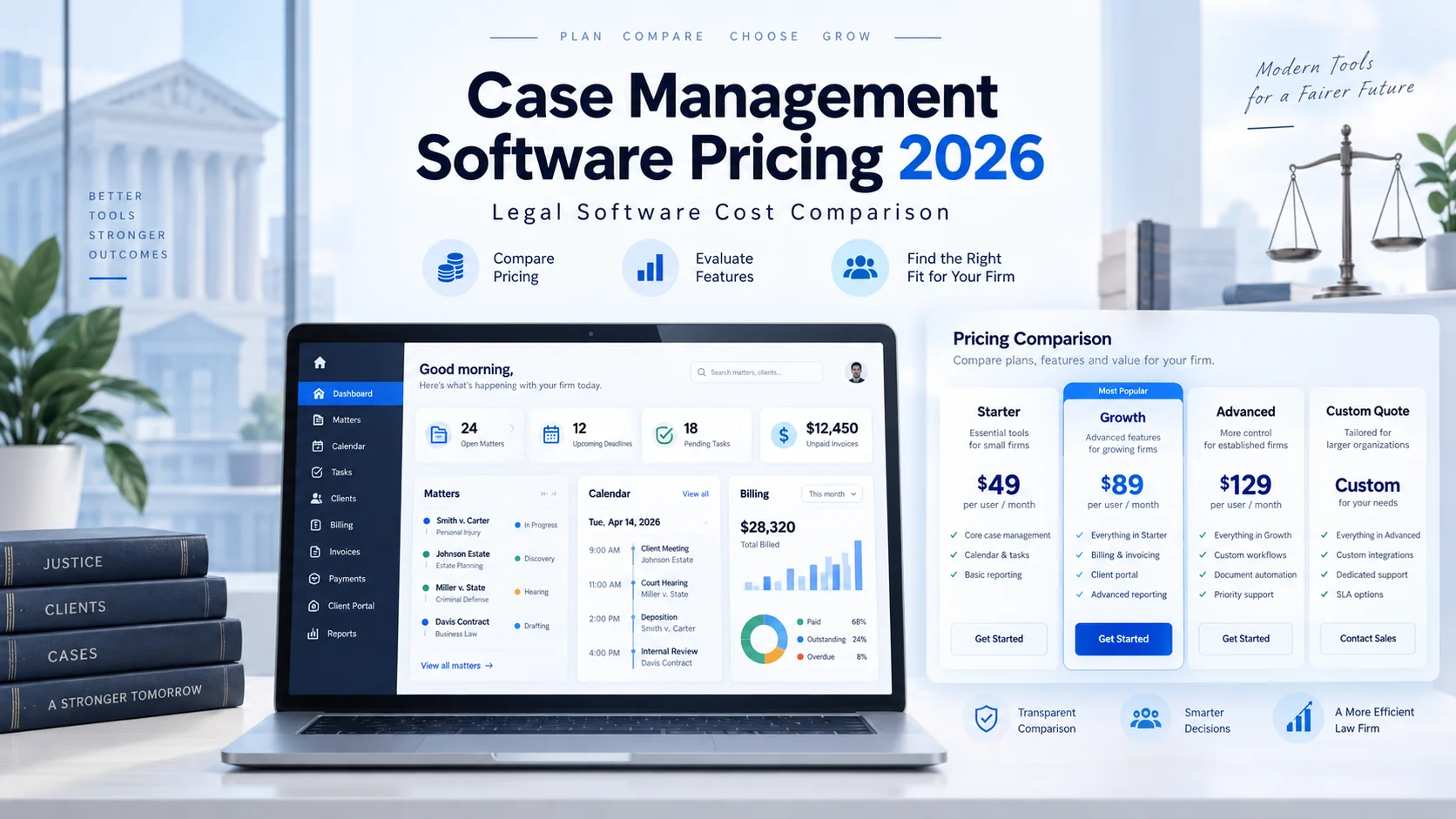
Case management software pricing for law firms in 2026 ranges from roughly $49 per user per month at the transparent entry end to custom enterprise quotes for larger platforms. This guide focuses specifically on legal case management software, because the broader term "case management software" is also used in healthcare, social services and government.
Current public examples include PracticePanther from $49/user/month, CosmoLex from $49/user/month, MyCase from $50/user/month when billed annually, and Clio Manage starting at $49/user/month in the U.S. Smokeball and Filevine use custom quotes rather than one universal public price.
The sticker price is only part of the real legal case management software cost. Payment processing, intake and CRM, accounting, e-signatures, AI, court-rules tools, migrations, data cleanup, implementation, integrations and annual contract terms can materially change what a firm actually pays.
Key takeaways
- PracticePanther currently lists Solo at $49, Essential at $69, Business at $89 and Business Pro at $114 per user/month.
- CosmoLex currently lists Launch at $49, Core at $99 and Pro at $129 per user/month, with an advertised $120/user annual-billing saving.
- MyCase currently lists Basic at $60 monthly or $50 billed annually, Pro at $120 monthly or $100 annually, and Advanced at $150 monthly or $130 annually.
- Clio Manage currently starts at $49/user/month in the U.S.; higher current tiers are quote-led on the main pricing page.
- Smokeball currently uses quote-based pricing across Bill, Boost, Grow and Prosper+.
- Filevine builds custom packages around Matters, Intake, Signatures, AI/LOIS and related extensions rather than publishing one universal rate.
- Per-user pricing means a small tier difference becomes thousands of dollars per year as headcount grows.
- Payment fees can exceed the subscription cost for firms processing significant client payments.
- Accounting, intake, texting, e-signature and AI can either reduce total stack cost or force an expensive tier upgrade.
- Three-year TCO is a better comparison than one monthly sticker price.
Scope: this article is about legal case management software
Searches for "case management software pricing" are ambiguous. Hospitals, government agencies, nonprofits and legal firms all use the phrase "case management." This page is intentionally scoped to law-firm and legal practice management systems so the pricing comparison remains coherent and does not mix unrelated industries.
The comparison focuses on systems that organize legal matters/cases, contacts, calendars, tasks, documents, billing, payments and client communication.
Cannibalization check and methodology
CostLoop already has vendor-specific pricing pages for Clio and PracticePanther. Those pages remain the authority for deep searches such as "Clio pricing" and "PracticePanther cost." This page owns category-level "case management software pricing" and "legal case management software pricing" comparison intent.
For the Clio plan deep dive, use Clio Pricing 2026. For the PracticePanther plan deep dive, use PracticePanther Pricing 2026.
Related CostLoop guides
- Clio Pricing 2026
- PracticePanther Pricing 2026
- Software Budget Template
- Hidden Costs of SaaS
- Annual vs Monthly SaaS Billing
- How to Negotiate SaaS Pricing
- Renewal Tracker for Software Subscriptions
- What to Store With Every Software Subscription Record
- SaaS Cost Management
- CostLoop Features
- CostLoop Pricing
Legal case management software pricing at a glance
| Vendor | Current 2026 public pricing signal | Model | Main cost risk |
|---|---|---|---|
| PracticePanther | $49 / $69 / $89 / $114 per user/month | Per user | Tier upgrades across every seat + payments |
| CosmoLex | $49 / $99 / $129 per user/month | Per user | Accounting/CRM/payment scope and billing term |
| MyCase | Annual: $50 / $100 / $130; Monthly: $60 / $120 / $150 per user/month | Per user | Large tier jumps + payment fees |
| Clio | Starts at $49/user/month; higher tiers quote-led | Per user + quoted tiers | Higher-tier pricing + add-ons/payments |
| Smokeball | Custom quote | Plan + users + options | Quote opacity, add-ons, migration |
| Filevine | Custom quote | Custom package | Package extensions, implementation, AI/intake scope |
PracticePanther pricing
PracticePanther is one of the easiest legal case management products to model because it currently publishes four per-user plans: Solo $49, Essential $69, Business $89 and Business Pro $114 per user/month.
Business is where intake forms, native two-way texting, unlimited native eSignature sends, LEDES billing and stronger reporting appear. Business Pro adds PantherAccounting Plus, trust and operating accounting, reconciliation and deeper financial workflows.
PantherPayments currently lists 2.95% for cards and 1% for eCheck, with no PracticePanther monthly payment-processing fee or setup fee, although card-brand network fees can apply.
See the full vendor analysis in PracticePanther Pricing 2026.
CosmoLex pricing
CosmoLex currently publishes Launch at $49/user/month, Core at $99/user/month and Pro at $129/user/month on its pricing page. CosmoLex also advertises a $120 per user saving with yearly billing.
CosmoLex is important in a legal-software cost comparison because practice management and legal accounting are part of the same product family. A higher CosmoLex tier can still be cheaper at the stack level if it replaces separate billing, trust accounting or CRM products.
CosmoLex billing documentation also says ACH payments for the CosmoLex subscription itself can avoid a payment-method fee, while credit-card subscription payments may have a 3% surcharge and accounts with no payment method on file can face a $50 manual-processing convenience fee. Those are vendor billing mechanics, not client payment-processing rates.
MyCase pricing
MyCase currently has Basic, Pro and Advanced tiers with both monthly and annual billing. Basic is $60/user/month monthly or $50/user/month billed annually. Pro is $120 monthly or $100 annual-billing equivalent. Advanced is $150 monthly or $130 billed annually.
MyCase says there is no setup fee or long-term obligation, but cancelling does not produce a refund for the remaining term. The subscription stays active until the paid period expires.
MyCase's 2026 payment migration documentation lists 2.99% + $0.30 for Visa/Mastercard/Discover, 3.9% + $0.30 for American Express, 1% for eCheck, a $10 returned eCheck fee and a $25 chargeback fee. Firms that do not validate PCI compliance after the grace period may also face a $19.95 monthly non-compliance fee.
| MyCase plan | Monthly billing | Annual-billing equivalent | Annual cost per user |
|---|---|---|---|
| Basic | $60/mo | $50/mo | $600/yr |
| Pro | $120/mo | $100/mo | $1,200/yr |
| Advanced | $150/mo | $130/mo | $1,560/yr |
Clio Manage pricing
Clio Manage currently starts at $49/user/month in the U.S. The current plan structure is Starter, Core, Signature and Elite, but Clio's main U.S. pricing page directs buyers to get pricing for the higher tiers instead of publishing one universal public dollar amount.
The existing CostLoop Clio article goes deeper into plan differences, payment fees and add-ons. This category page deliberately keeps Clio concise so the two URLs do not compete.
See Clio Pricing 2026: Plans & Legal Software Costs for the detailed current breakdown.
Smokeball pricing
Smokeball currently offers Bill, Boost, Grow and Prosper+ but uses "Get pricing" rather than displaying a universal dollar rate. Smokeball says pricing depends on the number of users, selected plan, contract term and optional products/services.
The plan structure matters because AutoTime is included in Prosper+ but is an add-on for Grow, while Intake and AI capabilities are packaged differently across tiers. Migration services and related costs are confirmed in the quote.
For Smokeball, do not accept a comparison table that gives you one exact per-user number without a current written quote. Normalize the same modules, user count and migration scope instead.
Filevine pricing
Filevine currently uses custom-built packages rather than public list pricing. Its Matters package can be extended with analytics, deadline management, client portal, DataBridge and integrations, while separate Intake, Signatures and AI/LOIS products can expand the commercial scope.
Filevine also highlights certified implementation partners for onboarding and customization. That makes implementation scope especially important when comparing Filevine against simpler per-user legal practice management systems.
5-user firm cost comparison
For vendors with transparent public pricing, five paid users show how quickly tier choices change the annual software budget.
| Vendor / plan | Monthly cost for 5 users | Annualized cost |
|---|---|---|
| PracticePanther Solo $49 | $245 | $2,940 |
| PracticePanther Business $89 | $445 | $5,340 |
| PracticePanther Business Pro $114 | $570 | $6,840 |
| CosmoLex Launch $49 | $245 | $2,940 |
| CosmoLex Core $99 | $495 | $5,940 |
| CosmoLex Pro $129 | $645 | $7,740 |
| MyCase Basic annual $50 | $250 eq. | $3,000 |
| MyCase Pro annual $100 | $500 eq. | $6,000 |
| MyCase Advanced annual $130 | $650 eq. | $7,800 |
| Clio Starter floor $49 | $245 | $2,940 |
10-user firm cost comparison
| Vendor / plan | Monthly cost for 10 users | Annualized cost |
|---|---|---|
| PracticePanther Solo $49 | $490 | $5,880 |
| PracticePanther Business $89 | $890 | $10,680 |
| PracticePanther Business Pro $114 | $1,140 | $13,680 |
| CosmoLex Launch $49 | $490 | $5,880 |
| CosmoLex Core $99 | $990 | $11,880 |
| CosmoLex Pro $129 | $1,290 | $15,480 |
| MyCase Basic annual $50 | $500 eq. | $6,000 |
| MyCase Pro annual $100 | $1,000 eq. | $12,000 |
| MyCase Advanced annual $130 | $1,300 eq. | $15,600 |
| Clio Starter floor $49 | $490 | $5,880 |
20-user firm: why small plan differences become large
At 20 paid users, a $20/user/month difference equals $400/month or $4,800/year. A $50/user/month difference equals $12,000/year.
| Plan-rate difference | 20-user monthly impact | Annual impact |
|---|---|---|
| $10/user/mo | $200 | $2,400 |
| $20/user/mo | $400 | $4,800 |
| $25/user/mo | $500 | $6,000 |
| $50/user/mo | $1,000 | $12,000 |
That is why one feature locked behind a higher tier can have a much larger cost than it appears to have on the pricing page.
The six cost drivers that matter more than the headline price
1. Paid user count. Every attorney, paralegal, billing user and administrator can increase a per-user subscription. Define who truly needs a full login.
2. Intake and CRM. Lead capture, intake forms, scheduling and follow-up can be built in, tier-gated or sold separately. Compare against the cost of a standalone intake product.
3. Payments. Card and eCheck fees scale with client payment volume and can exceed the software subscription itself.
4. Accounting. Trust accounting, operating accounting and reconciliation can eliminate separate accounting tools, but they often sit on higher tiers.
5. AI, automation and eSignature. Modern legal systems increasingly gate AI, document automation, e-signature and workflow automation by tier or package.
6. Migration and implementation. Matter data, documents, contacts, trust balances, billing history and custom workflows all create migration and validation work.
Payment-processing cost can dwarf the subscription
A 10-user firm may spend $5,000-$15,000 per year on legal case management subscriptions, but card-processing cost can be much larger if the firm collects significant client payments through the platform.
| Monthly client payments | 2.95% card fee | 2.99% + $0.30 example* |
|---|---|---|
| $25,000 | $737.50 | about $747.50 before transaction-count effect |
| $50,000 | $1,475 | about $1,495 before transaction-count effect |
| $100,000 | $2,950 | about $2,990 before transaction-count effect |
*The +$0.30 component depends on the number of transactions, so the table only illustrates the percentage component plus a rough placeholder. Use actual transaction counts for a precise model.
Monthly vs annual billing
MyCase makes the difference especially clear: its annual plans are $10-$20/user/month cheaper than the corresponding monthly rates. PracticePanther advertises $120/user/year annual savings, and CosmoLex also advertises $120/user annual savings.
Annual billing is attractive only if the firm expects to keep the product and seat count for the full term. For a fast-changing firm, monthly flexibility can be worth the premium. See CostLoop's Annual vs Monthly SaaS Billing for the general framework.
Hidden fees and overlooked legal software costs
- Payment-processing fees
- PCI non-compliance or chargeback fees where applicable
- External court-rules subscriptions
- Intake/CRM add-ons
- AI assistants
- eSignature limits or add-ons
- Advanced reporting
- Accounting modules
- API or premium integration access
- Data migration
- Document conversion and cleanup
- Training and workflow configuration
- Third-party document storage or Microsoft 365
- Renewal uplift and seat growth
For the broader pattern, see Hidden Costs of SaaS.
Three-year total cost of ownership
Retired-tool savings matter. A higher-priced platform that replaces separate intake, eSignature, accounting or texting subscriptions can have a lower stack-level cost than a cheaper entry plan.
3-year TCO =
subscriptions + payment fees + add-ons
+ migration/implementation + integrations + external tools
+ internal admin time + renewal increases
- retired-tool savings
How to compare two legal case management quotes fairly
- Use the same number of paid firm users in every quote.
- Match the same workflows: matters, documents, calendar, billing, payments, intake, eSignature, accounting and reporting.
- Separate monthly subscription from payment-processing rates.
- Add required add-ons and external services.
- Use the same migration scope and historical-data requirement.
- Normalize monthly vs annual billing.
- Calculate Year 1 and three-year TCO.
- Model expected staff growth over the contract.
- Compare cancellation, refund and renewal terms.
- Identify which existing tools can actually be retired after migration.
Which pricing model is best for a small law firm?
For small firms, transparent per-user pricing is easier to budget than a custom quote. But easy-to-budget does not automatically mean cheaper. The deciding factor is how much functionality is included at the tier the firm genuinely needs.
A $49 entry plan can become expensive if the firm immediately needs intake, texting, accounting or advanced automation and must upgrade every user. A $99 plan can be cheaper at the stack level if it removes $300-$500/month of separate software.
When a quote-based platform can make sense
Smokeball and Filevine can make sense for firms that need a deeper workflow, specialized practice-area automation, analytics, AI or implementation support. Custom pricing is not inherently bad; it simply requires stronger procurement discipline.
Ask for the recurring license, one-time migration, onboarding, optional modules and renewal rules as separate line items so a discounted Year 1 package does not hide an expensive Year 2.
Negotiating legal case management software
- Use competing quotes at the same seat count and workflow scope.
- Ask for annual-billing and multi-year options separately.
- Request migration and onboarding concessions before signing.
- Ask whether intake, AI, eSignature or accounting can be added selectively rather than upgrading every user.
- Negotiate seat reductions for departing staff and future growth bands.
- Get payment-processing rates and network/chargeback fees in writing.
- Ask for renewal-uplift caps.
For a negotiation framework, see How to Negotiate SaaS Pricing.
What to store with a legal case management subscription
- Vendor and plan
- Paid users
- Per-user rate
- Billing cycle
- Annual contract value
- Payment-processing rates
- Intake / CRM modules
- Accounting modules
- AI / automation modules
- Integration list
- Migration scope
- Renewal and notice dates
- Refund/cancellation rules
- Order form and pricing exhibit
- Internal owner and finance owner
Use What to Store With Every Software Subscription Record as the broader record template. For renewal review, use CostLoop's Renewal Tracker, and for the wider budgeting process, see SaaS Cost Management.
Frequently asked questions
How much does case management software cost in 2026?
For legal case management software, transparent entry plans commonly start around $49-$60 per user per month, while advanced tiers can exceed $100-$150 per user per month. Some platforms such as Smokeball and Filevine use custom quotes.
What is legal case management software pricing based on?
Most legal products charge per paid user, but plan tier, intake, accounting, AI, payments, integrations and migration can materially change total cost.
What is the cheapest legal case management software in this comparison?
At the current public entry level, PracticePanther Solo, CosmoLex Launch and Clio's published starting point are all around $49/user/month. MyCase Basic is $50/user/month when billed annually or $60 monthly.
How much does MyCase cost?
MyCase currently lists Basic at $60 monthly or $50 annually billed, Pro at $120 monthly or $100 annually billed, and Advanced at $150 monthly or $130 annually billed, all per user.
How much does PracticePanther cost?
PracticePanther currently lists Solo at $49, Essential at $69, Business at $89 and Business Pro at $114 per user/month.
How much does CosmoLex cost?
CosmoLex currently lists Launch at $49, Core at $99 and Pro at $129 per user/month, and advertises a $120/user saving with yearly billing.
How much does Clio cost?
Clio Manage currently starts at $49/user/month in the U.S. Higher current tiers on the main pricing page require pricing from Clio rather than showing one universal public dollar amount.
How much does Smokeball cost?
Smokeball currently uses custom pricing based on firm users, selected plan, contract term and optional products/services.
How much does Filevine cost?
Filevine currently builds custom packages based on the firm's selected Matters, Intake, Signatures, AI and extension needs. It does not publish one universal list price.
What hidden costs should law firms check?
Payment processing, intake/CRM, accounting, eSignature, AI, court-rules tools, integrations, migration, training, chargeback/compliance fees and renewal increases are the main extra cost categories.
Final verdict
Case management software pricing for law firms is easy to misread because vendors bundle different pieces of the legal workflow. A $49 plan with separate intake, accounting and eSignature can cost more than a $99 plan that replaces those tools.
The best comparison is not price per user alone. It is the total annual cost for the same number of users and the same operating scope, including payment processing and migration.
Clio and PracticePanther stay vendor-specific deep dives, while this page remains the legal category comparison for case management software pricing.

About the author
Milosh Mladenovski is a CostLoop founder and works on subscription discovery, license inventory and recurring software cost workflows. Author profile · LinkedIn