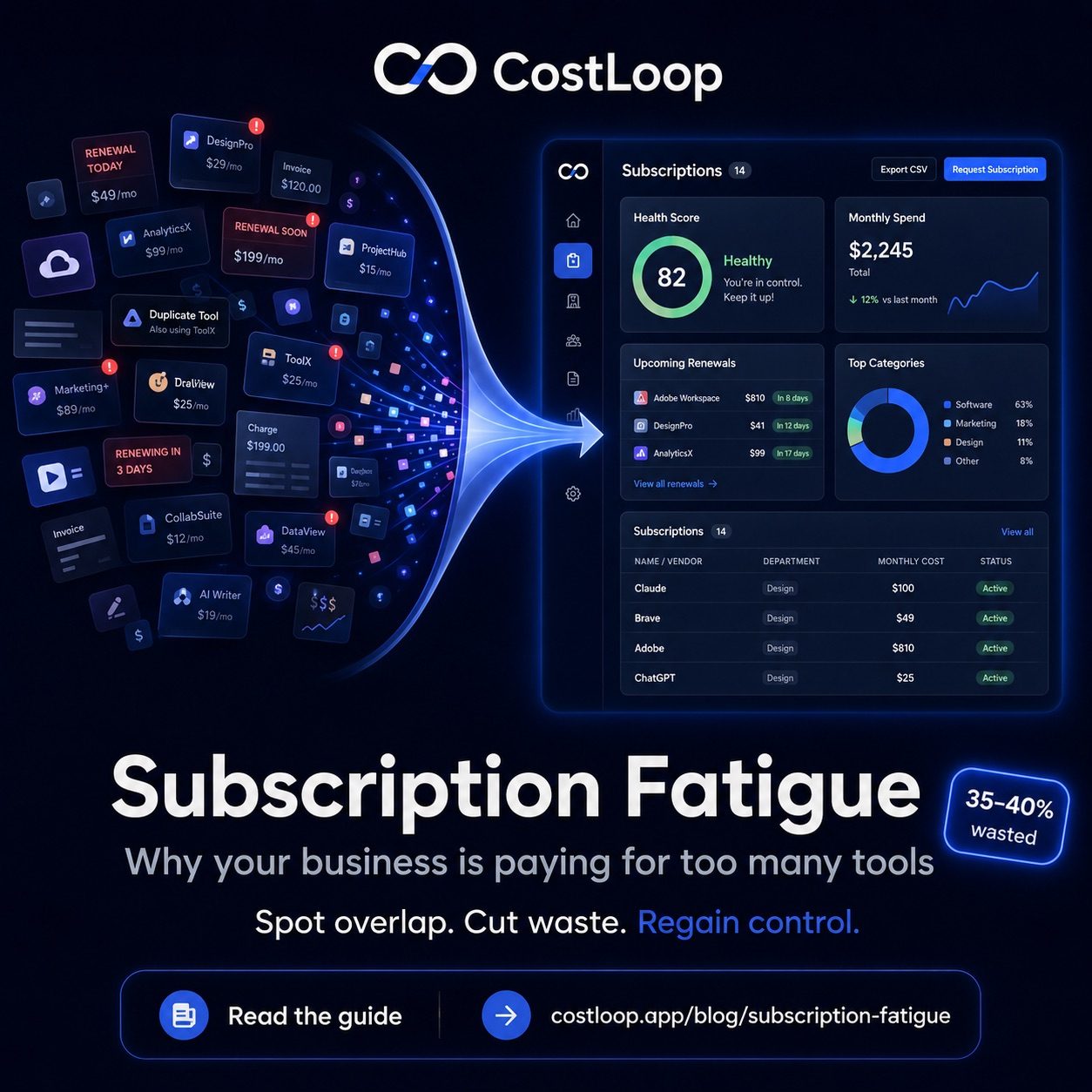
Subscription fatigue isn't just a personal problem with Netflix and Spotify. It's a real financial pattern in small and medium businesses, and it's expensive. It happens when your stack of software tools grows faster than your ability to actually use and manage them - when the costs pile up while the value delivered stays flat or shrinks. A small or medium business can easily accumulate more SaaS subscriptions than it actively uses. The unused portion is money leaving the account every month for little return.
The tricky part is that it doesn't feel like a problem until you sit down and total it up. Individual subscriptions are small enough to ignore. Together, they're a meaningful chunk of operating costs that nobody consciously decided to spend.
How subscription fatigue happens
It rarely starts with bad decisions. Every subscription in your stack was probably a reasonable choice at the time. The problem is what happens after: tools accumulate and recurring costs pile up because removing them requires more friction than keeping them.
Free trials are the most common starting point. The tool solved a specific problem during the trial period, the trial ended, the card got charged, and nobody cancelled because the problem was solved and the tool was "there" in case it was needed again. SaaS free trial traps are one of the most reliable ways subscriptions creep in under the radar.
Team members add tools for specific projects. The project ends. The tool stays. A team member leaves and the tools they signed up for keep billing. New tools get adopted without retiring old ones that do the same job. Over 12–24 months, these additions stack up into a portfolio that nobody deliberately chose and nobody is fully using.
The psychological part nobody talks about
Subscription fatigue has a behavioral component that makes it persist even once you know about it. Three patterns keep underperforming tools alive longer than they should be:
Switching cost inflation. Moving off a tool feels harder than it is. You imagine migrating data, retraining the team, rebuilding workflows. In most cases, the actual effort is an afternoon. But the imagined effort is enough to make "cancel it" feel too disruptive, so the tool keeps billing while you "plan the migration."
The sunk cost of annual subscriptions. Once you've paid for a year upfront, the "well, we've already paid for it" logic kicks in. Prepayment does not guarantee usage, and it can still feel wrong to cancel something you've "already paid for," even though the money is gone either way.
Small amounts feeling trivial. Small monthly tools can get ignored in a way that large annual contracts never would. The same behavior, framed differently. Multiply several small tools across your stack and you can end up with recurring spend that was never consciously approved.
Signs your business has subscription fatigue
You don't need to run a full audit to spot the symptoms. If several of these apply to your business, subscription fatigue is already costing you money:
| Symptom | What it signals |
|---|---|
| You can't name your total monthly software spend off the top of your head | Stack has grown beyond what you're actively managing |
| You discover charges while doing something else (reviewing expenses, noticing a card charge) | Untracked tools running without oversight |
| Multiple team members use different tools for the same task | Duplicate spend, no standardized stack |
| You have tools nobody on the current team set up | Orphaned subscriptions from old projects or team members |
| Adding new tools without evaluating existing ones first | No one-in-one-out discipline; stack grows without review |
The fix: do a reset, then build habits
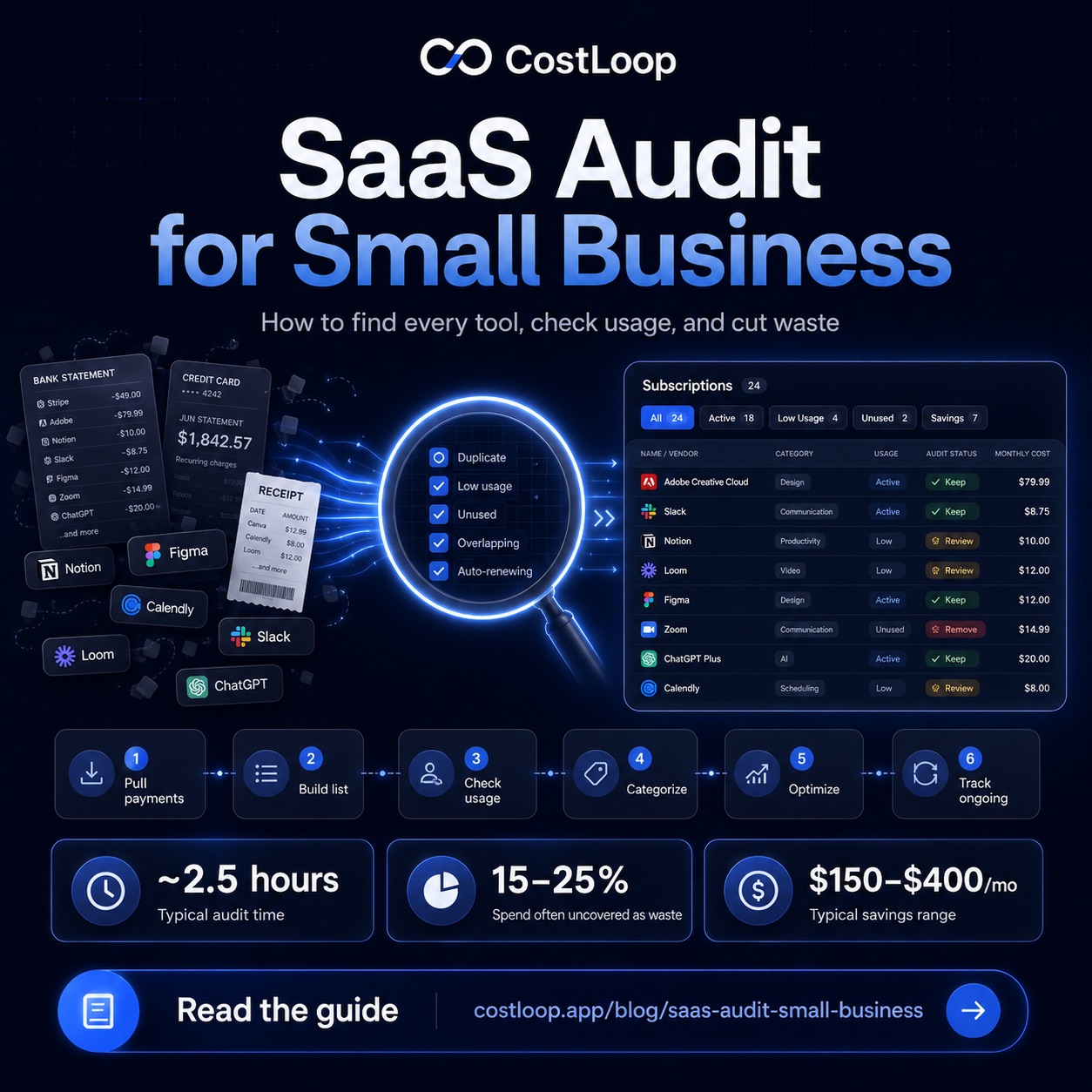
The reset is a one-time full audit: find everything, make a decision on each one, and cancel what you should not be paying for. The SaaS audit guide walks through this in detail. The outcome depends on your stack, but the process gives every subscription an owner and a decision. The subscription audit checklist is a faster version if you want to work through it item by item.
The habits are what prevent it from coming back. Three are worth building:
Set a monthly software budget cap. Decide the maximum your business will spend on software each month. Any new tool that pushes you past the cap requires cancelling something else first. This creates a forcing function for evaluation that doesn't depend on anyone remembering to check.
Adopt a one-in-one-out policy. Before approving any new tool, the team must identify what it replaces or why the budget allows for an addition. This doesn't mean every new tool needs to retire an old one - but it forces the comparison to happen before signup, not after the trial converts.
Set a quarterly review reminder. Put 20 minutes on the calendar every three months. Open the tool list, check for anything that's no longer being used, flag anything renewing in the next 90 days that needs a decision. This is far lighter than an annual audit and prevents the stack from drifting back into fatigue. More on when SaaS costs eating into profit become a real problem and what the warning signs look like before a full reset becomes necessary.
After the reset: staying healthy
A cleaned-up stack doesn't stay clean on its own. The same dynamics that created fatigue the first time - trials, team additions, forgotten tools - will recreate it unless you have infrastructure to catch them early.
The minimum viable setup: a single list of every tool, who owns it, what it costs, and when it renews. Every new tool gets added to this list immediately, not "when we get around to it." Renewal dates get flagged at least 30 days ahead so you make a conscious decision before the charge hits. For cutting costs once you've done the reset, the how to cut SaaS costs guide covers negotiation, downgrades, and alternatives.
After your reset, move everything into CostLoop, a subscription management tool whose health score feature flags tools showing signs of low usage before renewal creeps up on you. Renewal reminders force a decision. Every subscription visible in one place means you're never surprised by a charge. Check pricing - it's free to start.
Start free - no credit card neededSubscription fatigue as a SaaS spend management problem
Subscription fatigue - the feeling of being overwhelmed by the number, cost, and management burden of subscriptions - is a sign that your SaaS spend management system has broken down. It is not primarily a volume problem. It is a visibility and control problem.
When subscriptions are managed proactively, they stop feeling overwhelming: each one is tracked, each renewal is a decision, nothing charges unexpectedly. The fatigue comes from the opposite situation: subscriptions piling up, charges appearing unexpectedly, and no clear system for deciding what to keep. The accumulated uncertainty is what creates the feeling of being overwhelmed.
A subscription management app that sends reminders and shows your full stack at a glance is the practical cure for subscription fatigue. You don't need fewer subscriptions necessarily - you need a system that makes each one visible and each renewal deliberate. The SaaS spend management guide covers the policies that prevent the stack from drifting back into fatigue after a cleanup. For a cost-focused approach to reducing what you're spending, the SaaS cost management guide covers the steps from audit to ongoing control.
Frequently asked questions
What is subscription fatigue and subscription overload in business?
Subscription fatigue is when a business accumulates more software subscriptions than it actively uses or benefits from, resulting in wasted spending, tool overlap, and budget drain that compounds over time. Subscription overload is a related term for the same pattern: too many recurring costs managed by too few controls.
How many SaaS subscriptions does the average small and medium business have?
Small and medium businesses often discover subscriptions that are only partially used or no longer used at all.
How do I reduce subscription fatigue through tool consolidation?
Start with a full audit to see everything you're paying for. Cancel dead tools immediately, downgrade underused tools, and focus on tool consolidation - replacing overlapping tools with a single solution. Set a monthly software budget cap and review the list quarterly to prevent creep.
What is a one-in-one-out software policy?
A rule where adding any new SaaS tool requires cancelling or replacing an existing one. It prevents subscription creep by forcing the team to evaluate new tools against what they already have.
What causes subscription fatigue?
Accumulation of subscriptions without a management system. Each unexpected charge or unreviewed tool adds to the feeling of being overwhelmed. The cure is visibility and control - knowing exactly what you pay for, when each tool renews, and having a reminder system that prompts a decision before each charge. Fewer subscriptions is not always the answer; managed subscriptions are.