Pricing verified: August 21, 2026
Quick answer
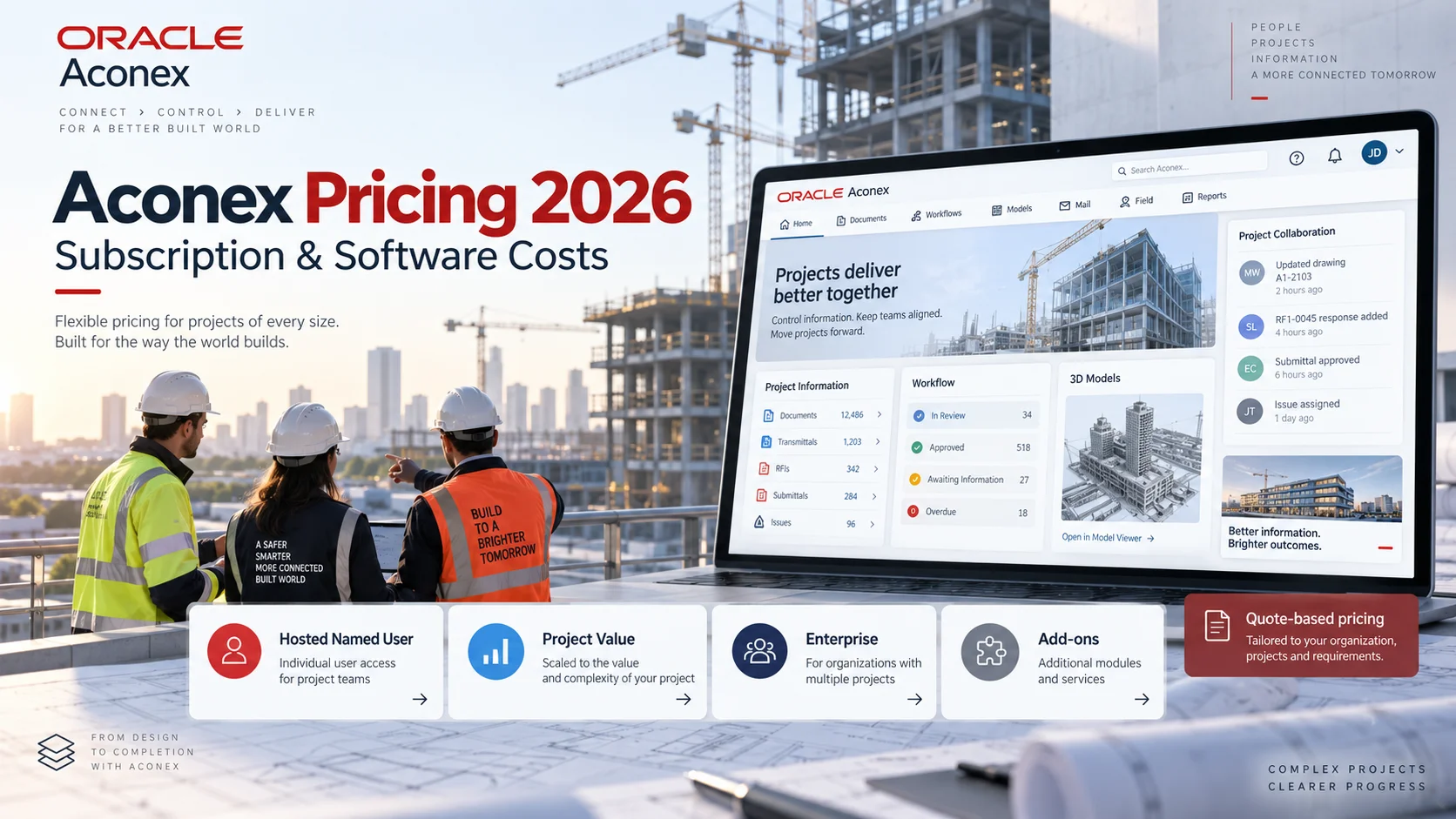
Oracle Aconex does not publish one simple commercial list price for every customer in 2026. Aconex is sold as a cloud construction collaboration platform, and Oracle's current service descriptions support multiple licensing metrics, including Hosted Named User, single-project Project Value, and enterprise Project Value Allowance.
That means the real Aconex subscription cost depends on the commercial model written into your Oracle order: how many hosted named users are covered, whether the purchase is for one project or an enterprise portfolio, the project value or project-value allowance where that metric is used, and which add-on cloud services are included.
Oracle does publish some useful reference pricing in public-sector procurement documents. A May 2026 U.S. public-sector Oracle price list shows $58 for the Aconex Enterprise Cloud Service Hosted Named User SKU and $58 for the Single Project Hosted Named User SKU, with separate list fees for add-ons such as Connected Cost, Model Coordination, Handover, Scheduled Archive and Defects Liability. Those figures are public-sector list references, not guaranteed commercial Aconex prices.
Key takeaways
- Oracle Aconex is quote-led for normal commercial buyers; there is no universal public commercial price table on the main product page.
- Current Aconex service descriptions support Hosted Named User licensing and Project Value / Project Value Allowance licensing.
- A Hosted Named User means a person authorized to access the cloud service, whether or not that person is actively using it at a given moment.
- Oracle's current documentation says Aconex Guest Users can count as Hosted Named Users under the relevant enterprise licensing model.
- Aconex Enterprise Cloud Service can allow unlimited projects during the service period when licensed under the applicable enterprise model, subject to the order and usage limits.
- Single Project licensing is designed around a designated project and can use Hosted Named User or Project Value metrics.
- Oracle's May 2026 U.S. public-sector list shows $58 for the base Hosted Named User SKU, but that is a procurement reference rather than a universal commercial rate.
- Connected Cost is a separate Aconex add-on and can be materially more expensive than lighter add-ons.
- Model Coordination, Handover, Scheduled Archive and Defects Liability can be separately licensed depending on the order and metric.
- Implementation, template development, consulting, migration, integrations, archives, project growth and renewal terms can all affect total Aconex cost.
In this guide
- How Oracle Aconex pricing works in 2026
- Hosted Named User pricing
- Single Project vs Enterprise licensing
- Project Value and Project Value Allowance
- Current U.S. public-sector price references
- Aconex add-on pricing structure
- Implementation and consulting costs
- Aconex vs Procore, Buildertrend and Bluebeam
- Three-year Aconex TCO
- Hidden fees and commercial risks
Methodology and disclosure
This guide uses Oracle's current Aconex product page, current Oracle Aconex Cloud Service Descriptions and Metrics, current Aconex licensing information, and Oracle's May 21, 2026 U.S. public-sector price list. Commercial list pricing is not published on the normal Aconex product page, so this article does not invent a universal private-sector price.
Public-sector list figures are clearly labeled as such. They are useful for understanding Oracle part numbers, metrics and relative product structure, but actual commercial quotes can differ by region, customer, project scope, contract term, reseller, discounting and negotiated order.
CostLoop is not affiliated with Oracle and does not replace Aconex. Aconex manages construction and engineering project collaboration; CostLoop helps businesses track recurring software cost, ownership, contracts and renewal dates.
CostLoop already has dedicated pricing guides for Procore, Buildertrend and Bluebeam. Those pages have different search intent and different commercial models: Procore uses product selection plus Annual Construction Volume with generally unlimited users; Buildertrend uses custom pricing based on builder type, annual revenue and business needs with unlimited users/projects; Bluebeam uses transparent per-user annual subscriptions for AEC PDF and drawing workflows. Aconex uses Oracle cloud collaboration with Hosted Named User, Project Value and enterprise Project Value Allowance licensing structures.
Related CostLoop guides
- Procore Pricing 2026
- Buildertrend Pricing 2026
- Bluebeam Pricing 2026
- Project Management Software Pricing
- Hidden Costs of SaaS
- How to Negotiate SaaS Pricing
- Annual vs Monthly SaaS Billing
- SaaS Cost Management
- What to Store With Every Software Subscription Record
- Renewal Tracker for Software Subscriptions
- CostLoop Features
- CostLoop Pricing
How Oracle Aconex pricing works
Aconex is not priced like a simple self-serve project-management app. Oracle's current service descriptions show several commercial metrics. The metric in your order determines what actually drives the bill.
| Licensing metric | What it means | What can increase cost |
|---|---|---|
| Hosted Named User | A named person authorized to access Aconex, whether or not actively using it | More covered users, guest users, add-ons tied to matching user quantity |
| 1M of Project Value | One million USD (or local-currency equivalent in the order) of the value of one designated project | Higher project value, longer/different project scope, matching add-ons |
| 1M of Project Value Allowance | One million USD of cumulative enterprise project-value consumption covered by the order | Portfolio growth, additional projects, changed project values |
| Customer | Flat customer-level metric used by certain early-access/add-on services | Additional customer-level service orders |
Hosted Named User pricing
Hosted Named User is the easiest Aconex metric to understand. Oracle defines it as an individual authorized by the customer to access the cloud service, regardless of who invited the person and whether the person is actively accessing the service at a given moment.
Oracle's current enterprise service description also states that Aconex Guest Users are considered Hosted Named Users under the applicable Hosted Named User model. That point matters because construction projects can involve many external participants.
Do not estimate Aconex cost from your internal employee count alone. Ask Oracle exactly which external participants, guests, consultants and delivery partners consume Hosted Named User quantity under your order.
Enterprise Cloud Service vs Single Project Cloud Service
Oracle Aconex supports enterprise and single-project commercial structures. The enterprise model is designed for organizations operating multiple projects, while the single-project model limits the order to a designated project.
Oracle's current enterprise service description says customers may provision an unlimited number of projects during the services period under the applicable enterprise order, subject to the order's user/project-value limits and other terms. Single Project orders are tied to the project identified in the order.
| Question | Enterprise Cloud Service | Single Project Cloud Service |
|---|---|---|
| Typical scope | Portfolio / multiple projects | One designated project |
| Possible metrics | Hosted Named User or Project Value Allowance | Hosted Named User or Project Value |
| Project count | Can support unlimited projects under applicable order | Designated single project |
| Best budgeting question | How will portfolio/user quantity grow? | How large is the project and how many covered users? |
Project Value pricing
Project Value is Oracle's definition of the cost of the project managed through Aconex over the duration of the project. When Aconex is purchased on a single-project Project Value metric, the order specifies the amount of project value covered.
Oracle's service descriptions state that if the project value increases during the service period, the customer may need an order or amendment and additional fees can apply. That means scope growth can become a software-cost driver even when the number of users stays flat.
For portfolio-level enterprise licensing, Project Value Allowance covers cumulative project-value consumption during the services period rather than one single project.
Current Oracle public-sector pricing references
Oracle's May 21, 2026 U.S. public-sector price list provides one of the clearest current official pricing references available publicly. These are public-sector list entries, not guaranteed private-sector commercial prices.
| Oracle Aconex public-sector SKU | Metric | May 2026 U.S. list reference |
|---|---|---|
| Aconex Enterprise Cloud Service | Hosted Named User | $58 |
| Aconex Single Project Cloud Service | Hosted Named User | $58 |
| Aconex Connected Cost Enterprise | Hosted Named User | $350 |
| Aconex Model Coordination Enterprise | Hosted Named User | $11 |
| Aconex Handover Enterprise | Hosted Named User | $10 |
| Aconex Scheduled Archive Enterprise | Hosted Named User | $5 |
| Aconex Defects Liability Single Project | Hosted Named User | $4 |
The same public-sector list also contains formula-based prices for Project Value metrics. Because those formulas depend on project value and contract months, they should not be converted into a generic Aconex "starting price" without the actual project assumptions.
What the $58 public-sector user reference would mean at different sizes
The table below is only arithmetic on the May 2026 U.S. public-sector list reference. It is not a commercial quote and should not be used as a promise of private-sector pricing.
| Hosted Named Users | $58 reference × users | 12-month arithmetic |
|---|---|---|
| 5 | $290/month reference | $3,480/year reference |
| 10 | $580/month reference | $6,960/year reference |
| 25 | $1,450/month reference | $17,400/year reference |
| 50 | $2,900/month reference | $34,800/year reference |
| 100 | $5,800/month reference | $69,600/year reference |
Again, actual commercial pricing can be discounted, structured around Project Value instead, bundled with services, or governed by other Oracle order terms.
Aconex add-on pricing structure
Aconex cost can expand beyond the base service. Oracle's current service descriptions and price lists show multiple add-on cloud services, some of which must match the core license metric or quantity.
Connected Cost
Adds cost-management capabilities and is a materially larger add-on in Oracle's public-sector Hosted Named User list than lighter modules. Treat it as a major commercial decision rather than a small feature toggle.
Model Coordination
Adds model coordination functionality for BIM/design coordination. Oracle publishes separate Hosted Named User and Project Value variants.
Handover
Supports structured project handover and can be separately licensed by Hosted Named User or Project Value, depending on the service/order.
Scheduled Archive
Supports scheduled project archive delivery. It has its own licensing metric and should be budgeted separately where required.
Defects Liability
Oracle provides a defects-liability period under certain base services, while extended/specific defects-liability cloud services can be purchased separately.
What is included in the Aconex platform?
Oracle's current Aconex product and service descriptions list a broad construction-collaboration scope. Depending on the ordered service, core capabilities can include documents, workflows, directories, tasks, mail/correspondence, tenders, supplier documents, packages, field, contracts, mobile access, APIs, model coordination and security controls.
Aconex is designed around a common data environment with a complete project record and an unalterable audit trail. That is why its pricing should be evaluated as a project-information and collaboration platform rather than as a simple team task manager.
Implementation, onboarding and consulting costs
The subscription is only one part of Aconex total cost. Oracle's current service description says onboarding may require an Aconex Inclusive Service, and enterprise onboarding/renewal can require Template Development Service. Project-configuration changes can also require separate consulting services.
- Aconex onboarding / Inclusive Service where required
- Template development
- Project configuration
- Document register and metadata design
- Workflow templates
- Security / SSO configuration
- Data migration
- Project integrations / APIs
- Training and administrator enablement
- Consulting for changes to project configuration
- Archive / closeout requirements
Aconex vs Procore pricing
Aconex and Procore can overlap in large construction and capital-project environments, but their pricing logic is different. See the separate Procore Pricing 2026 guide for the full Procore model.
| Pricing question | Oracle Aconex | Procore |
|---|---|---|
| Primary public commercial rate | No universal commercial list rate | No universal public dollar rate |
| Core commercial metric | Hosted Named User and/or Project Value structures | Products + Annual Construction Volume |
| External collaboration | Can affect Hosted Named User count depending on order | Core model advertises unlimited users |
| Project scale effect | Project Value / Project Value Allowance can drive price | Annual Construction Volume drives price |
| Best comparison metric | Annual TCO per project / $1M project value / covered user | Annual TCO per $1M ACV / project |
Aconex vs Buildertrend pricing
Buildertrend targets residential construction and home builders more directly, while Aconex is designed for complex multi-organization construction and engineering collaboration.
Buildertrend's current pricing is custom and considers builder type, annual revenue and business needs, with unlimited users and projects. Aconex can instead use Hosted Named User or Project Value metrics. The two should therefore be compared by company/project profile rather than by one monthly sticker price. See Buildertrend Pricing 2026 for the vendor-specific breakdown.
Aconex vs Bluebeam pricing
Bluebeam is not a direct replacement for Aconex. Bluebeam focuses heavily on PDF markup, drawing review, measurements and Studio collaboration, while Aconex is a broader contractual project-information and common-data-environment platform.
Bluebeam is much easier to price because its current plans are annual per-user subscriptions. Aconex is structurally more complex and can be tied to users or project value. See Bluebeam Pricing 2026 for Bluebeam's transparent seat pricing.
Hidden Aconex costs and commercial risks
- Underestimating Hosted Named Users, especially external participants or guests
- Project Value increases during delivery
- Portfolio growth against enterprise Project Value Allowance
- Connected Cost and other add-on services
- Model Coordination or Handover requirements
- Archive and defects-liability requirements after project completion
- Template-development / onboarding services
- Consulting for project configuration changes
- API and integration work
- Data migration and metadata cleanup
- Multiple regional/secure deployment requirements
- Renewal repricing
- Project extensions beyond the original duration
- Taxes, currency and reseller/contract differences
For the general framework, see Hidden Costs of SaaS.
Three-year Aconex total cost of ownership
For Aconex, a three-year model should not assume the project value and user count stay fixed. Large capital programs change. Model the contract using base, expected-growth and high-growth scenarios.
3-year TCO =
core cloud service + add-ons + onboarding/template services
+ consulting + integrations + archives/closeout
+ internal administration + project/portfolio growth
+ renewal changes
Year 1 TCO = Aconex cloud subscription + add-ons + onboarding/template services + consulting + integrations + migration + internal implementation labor.
How to normalize an Aconex quote
- Identify the exact Aconex cloud service and Oracle part number.
- Confirm whether the pricing metric is Hosted Named User, Project Value, Project Value Allowance or another customer-level metric.
- Define every user type that counts against the order, including guests/external participants.
- Confirm the covered project value or portfolio allowance.
- List every add-on: Connected Cost, Model Coordination, Handover, archive, defects liability or others.
- Separate recurring cloud fees from onboarding, template development and consulting.
- Document the contract term and billing schedule.
- Ask how project-value or user growth is repriced mid-term.
- Model Year 1, Year 2 and Year 3 costs using realistic project changes.
- Compare the same collaboration/document-control scope against Procore or another shortlisted platform.
Negotiating Aconex pricing
- Ask Oracle to quote both Hosted Named User and Project Value structures if both are viable for your deployment.
- Use a realistic external-collaborator count, not only internal staff.
- Ask for the next project-value/user breakpoint before signing.
- Separate core service and add-ons so future removals are commercially clear.
- Ask for multi-year price protection or renewal-uplift limits.
- Get project-growth mechanics in writing.
- Negotiate implementation/template services at the same time as the subscription.
- Confirm archive and post-completion requirements before procurement closes.
- Avoid benchmarking your commercial quote against random third-party "starting prices" that do not state the Oracle metric.
For broader tactics, use How to Negotiate SaaS Pricing.
What to store with an Aconex subscription record
- Oracle Aconex service / part number
- Enterprise vs Single Project
- Pricing metric
- Hosted Named User quantity
- Project Value or Project Value Allowance
- Covered projects
- Add-ons
- Annual contract value
- Contract start/end dates
- Renewal notice date
- Onboarding / template-development services
- Consulting orders
- Archive / defects-liability terms
- Order form and pricing exhibit
- Oracle/reseller contact
- Business owner and technical owner
For the broader record structure, see What to Store With Every Software Subscription Record. For the wider process, see SaaS Cost Management and CostLoop's Renewal Tracker. For the annual-commitment trade-off, see Annual vs Monthly SaaS Billing.
Frequently asked questions
How much does Aconex cost in 2026?
Oracle does not publish one universal commercial Aconex price. Aconex can be licensed by Hosted Named User, Project Value or enterprise Project Value Allowance, so the exact cost depends on the Oracle order and project scope.
What is the Aconex subscription cost per user?
For normal commercial buyers, Oracle requires a quote. Oracle's May 2026 U.S. public-sector price list shows a $58 Hosted Named User list reference for the base Enterprise and Single Project cloud service, but that is public-sector procurement pricing, not a guaranteed private-sector rate.
What is the Oracle Aconex price?
The main Oracle product page is sales-led. The exact Oracle Aconex price depends on the service, licensing metric, quantity, project value, add-ons, contract term and negotiated order.
Does Aconex charge per user?
Aconex can be licensed per Hosted Named User, but Oracle also supports Project Value and Project Value Allowance metrics. Your order determines which model applies.
What is a Hosted Named User in Aconex?
Oracle defines a Hosted Named User as a person authorized to access the cloud service, whether or not the person is actively using it at a given time.
Do Aconex guest users count?
Oracle's current enterprise Hosted Named User service description says Aconex Guest Users are considered Hosted Named Users under that model.
Does Aconex charge by project value?
Yes, some Aconex cloud services use 1M of Project Value for a designated project or 1M of Project Value Allowance for enterprise portfolio consumption.
How much does Aconex Connected Cost cost?
Oracle does not publish one universal commercial rate. The May 2026 U.S. public-sector list shows a $350 Hosted Named User reference for Connected Cost Enterprise, but actual commercial pricing should be confirmed in an Oracle quote.
Is Aconex cheaper than Procore?
There is no universal answer because Aconex and Procore use different metrics. Normalize both quotes to the same project scope, products, users, project/annual construction value, implementation and three-year TCO.
What hidden costs should I check in an Aconex quote?
Check add-ons, onboarding, template development, consulting, integrations, user growth, project-value growth, archives, defects-liability requirements and renewal terms.
Final verdict
Aconex pricing in 2026 is not a normal self-serve SaaS rate card. Oracle supports multiple Aconex commercial metrics, including Hosted Named User and project-value-based licensing, and the correct metric depends on whether the deployment is single-project or enterprise.
The strongest public pricing evidence comes from Oracle procurement documents, but those figures should be used as reference points rather than universal commercial prices. For an actual purchase, the Oracle order is the source of truth.
Before approving Aconex, define the user population, project value, portfolio growth, required add-ons, implementation scope and project-closeout requirements. Then calculate three-year TCO and compare the same scope with Procore, Buildertrend or another appropriate construction platform.

About the author
Milosh Mladenovski is a CostLoop founder and works on subscription discovery, license inventory and recurring software cost workflows. Author profile · LinkedIn