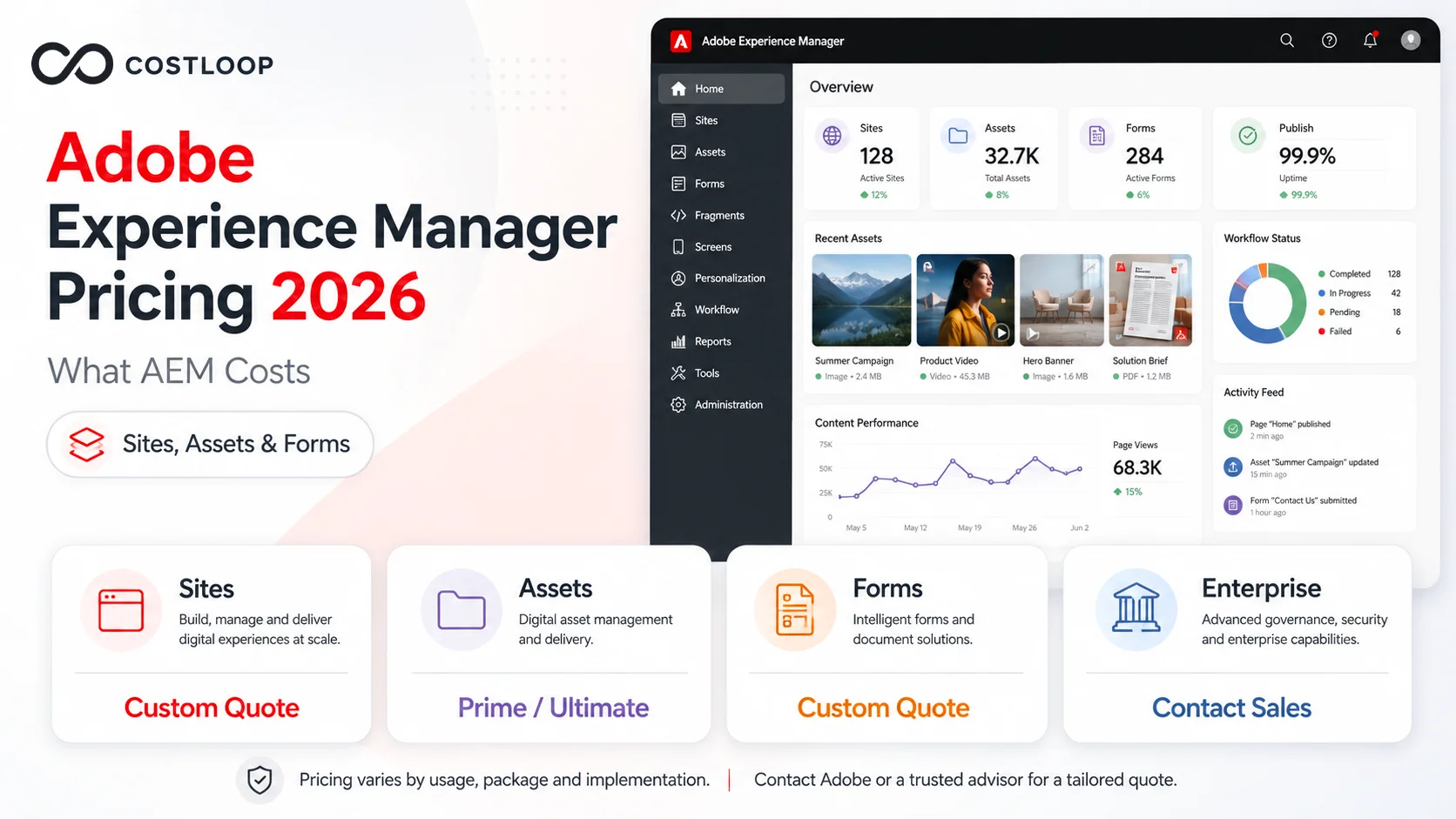
Last pricing verification: September 3, 2026
Quick answer
If you are searching adobe experience manager cost, the most accurate 2026 answer is that Adobe does not publish one universal list price for Adobe Experience Manager. AEM is sold through customized enterprise quotes, and the amount depends on which Experience Manager products you license, the usage metric in your sales order, user and storage entitlements, add-ons, security requirements, environments, implementation scope, and the wider Adobe contract around it.
The current pricing pages for Adobe Experience Manager Sites, Assets, and Forms all direct buyers to "Get pricing" rather than displaying a public dollar amount. The useful part is that Adobe's current product description, effective September 2, 2026, now makes the licensing mechanics unusually clear: AEM Sites is licensed by Content Requests per month; new AEM Assets customers license either Prime or Ultimate base packages; and AEM Forms is licensed around annual Form Submissions or Document Renditions.
Real AEM cost = Adobe license quote + required usage capacity + extra users/storage/add-ons + implementation/migration + integrations + partner/agency services + internal operating cost + renewal changes
That distinction matters. AEM is not a normal $20-per-user CMS. A buyer can pay for the platform, traffic or usage capacity, asset-management entitlements, extra environments and security, then spend a second budget on implementation and ongoing engineering. Any article that gives one neat "Adobe Experience Manager price" without explaining what is included is oversimplifying the product.
Key takeaways
- Adobe does not currently publish one universal public AEM price for Sites, Assets, or Forms.
- AEM Sites Cloud Service is licensed by Content Requests per month, not simply by named user.
- The current AEM Sites author tier includes up to 20 concurrent users when licensed up to 5 million Content Requests and up to 40 concurrent users at 5 million or more.
- New AEM Assets customers can only license AEM Assets Prime or AEM Assets Ultimate; older Enterprise and Essentials packages are renewal-only for existing customers.
- AEM Assets Prime currently includes 5 Power Users, 5 Collaborator Users, 50 Limited Users and 2 TB of production storage in its base package.
- AEM Assets Ultimate currently includes 10 Power Users, 15 Collaborator Users, 250 Limited Users and broader production/stage/development environment entitlements.
- Additional AEM cost can come from storage, user entitlements, Dynamic Media, extra environments, additional publish regions, higher SLA/security options, Forms, commerce integration and other add-ons.
- Public procurement and marketplace records show that AEM-related enterprise contracts can reach six figures, but those examples are contract-specific and should not be treated as Adobe list pricing.
- Implementation and migration can be a major part of first-year total cost, sometimes separate from the software license entirely.
- The only reliable budget number for your organization is a written Adobe or authorized-reseller quote with the licensing metrics and overage rules explicitly stated.
In this guide
- How Adobe Experience Manager pricing works in 2026
- AEM Sites licensing and cost drivers
- Adobe Experience Manager Assets pricing: Prime vs Ultimate
- AEM Forms pricing structure
- Public AEM cost benchmarks and what they actually mean
- AEM license cost vs implementation cost
- A practical AEM total-cost model
- Hidden costs and overage risks
- How to compare AEM quotes
- When Adobe Experience Manager is worth the cost
- Questions to ask Adobe before signing
- How to control the contract before renewal
Methodology and disclosure
This article is based primarily on Adobe's current public pricing pages and Adobe's Adobe Experience Manager as a Cloud Service Product Description, which is effective September 2, 2026. The legal product description is especially important because it identifies the current license metrics, base-package entitlements, user types, storage allowances and add-on metrics that do not appear as dollar figures on the marketing pricing pages.
Where Adobe publishes an entitlement or license metric, this guide uses it. Where Adobe requires a custom quote, this guide says so. We do not turn old reseller screenshots, legacy AEM pricing models, or random consulting estimates into a fake current Adobe list price.
Public procurement and marketplace examples are included only as supplementary scale signals. They represent specific government, security, reseller, implementation or legacy packaging contexts and are not substitutes for a current Adobe quote.
CostLoop publishes this guide and focuses on recurring software cost, license, contract and renewal control. For the buyer-side process around a platform like AEM, see the Software Budget Template, the SaaS Cost Management guide, and the Renewal Tracker.
Related CostLoop guides
- Digital Asset Management Software Pricing 2026
- Software Budget Template
- SaaS Cost Management
- Hidden Costs of SaaS
- How to Negotiate SaaS Pricing
- Software License Inventory
- Software License Lifecycle Management
- What to Store With Every Subscription Record
- CostLoop Features
- CostLoop Pricing
What is Adobe Experience Manager?
Adobe Experience Manager is not one single product with one single price. It is an enterprise content and experience-management family inside Adobe Experience Cloud. The core products most buyers mean when they say "AEM" are Experience Manager Sites for content management and digital experience delivery, Experience Manager Assets for digital asset management, and Experience Manager Forms for digital forms and document workflows.
That product structure is the first reason adobe experience manager price searches are messy. Two companies can both say they "use AEM" while paying for materially different products, capacity, user entitlements and service levels.
This is why comparing AEM with a normal seat-priced project-management or marketing tool is bad procurement. The economic model is different.
Adobe Experience Manager cost in 2026: what Adobe actually publishes
Adobe's public AEM pricing pages use a sales-led model. Sites says "Get customized pricing." Assets shows Prime and Ultimate, but both use "Get pricing." Forms likewise asks buyers to contact Adobe for customized pricing. No current official page gives a universal dollar list price that applies to every AEM buyer.
That does not mean AEM pricing is unknowable. It means the dollar price is private while the commercial mechanics are partly public. The Adobe product description shows exactly which units can drive the quote and which entitlements are included in a base package.
| AEM Product | Primary Job | Current Pricing Visibility | Current License Basis |
|---|---|---|---|
| AEM Sites | Enterprise CMS and experience delivery | Custom quote | Content Requests per month |
| AEM Assets Prime | Ready-to-use DAM | Custom quote | Per base package + add-on entitlements |
| AEM Assets Ultimate | Enterprise DAM with broader APIs/customization | Custom quote | Per base package + add-on entitlements |
| AEM Forms | Digital forms and document workflows | Custom quote | Form Submissions/year or Document Renditions/year |
AEM Sites pricing: licensed by Content Requests
The current AEM Sites Cloud Service license metric is Content Requests per month. Your sales order authorizes a quantity, and Adobe states that if your usage exceeds the licensed amount over the relevant 12-month period, you must license additional Content Requests.
That is a major change from older AEM articles that still describe Page Views as the main metric. Adobe's current September 2026 product description uses Content Requests. If a pricing guide is still centered on the old Page View model without qualification, it is stale.
What is included with AEM Sites?
Up to 20 concurrent author-tier users when the program is licensed up to 5 million Content Requests. Up to 40 concurrent author-tier users when the program is licensed for 5 million or more Content Requests. One Production Environment, one Stage Environment, one Development Environment and one Rapid Development Environment sharing the same code repository. Up to 1 TB of storage for Production, 1 TB for Stage, 200 GB for Development and 200 GB for the Rapid Development Environment. Adobe CDN by default, which gives Adobe visibility into Content Request usage. Content Fragments, Media Library and Experience Fragments functionality. One pack of Adobe Developer App Builder for new or renewed AEM Sites licenses covered by Adobe's current entitlement language.
What can increase AEM Sites cost?
The base quote is only the start. Adobe's current licensing description lists several add-ons and capacity dimensions that can increase cost: additional Content Requests when traffic or API usage exceeds the contracted amount, Concurrent User packs when the authoring organization needs more capacity than the included tier, additional Publish Regions licensed against the program's Content Request quantity, additional storage licensed per terabyte per year, additional development or specialized testing environments, Dynamic Media Prime or Ultimate licensed using operations or page-view style metrics, Commerce Integration Framework licensed using Content Requests per month, Enhanced Security or Extended Security for Healthcare where required, Customer Managed Keys, AEM Forms functionality beyond limited forms behavior, and Adobe Learning Manager, AEM Screens, Guides or other Experience Manager add-ons where relevant.
AEM Sites annual cost = quoted Sites license for contracted Content Requests + added capacity + add-ons + services + implementation/operations
AEM traffic can create overage risk
AEM Sites is not a simple "buy a license and forget it" product. Adobe explicitly ties the Cloud Service entitlement to Content Requests and requires additional licensing when contracted quantities are exceeded. If you use your own CDN instead of Adobe's, current terms also require auditable reporting of Content Request usage.
That makes forecasting important. Before procurement, ask the web/platform team for current CDN traffic, origin traffic, API volume, growth assumptions and launch plans. A content platform that looks affordable at today's traffic can become more expensive after a major international rollout or commerce launch.
Adobe Experience Manager Assets pricing in 2026
Adobe Experience Manager Assets pricing is also custom, but the packaging is clearer than Sites. Adobe's current pricing page presents two packages for new buyers: Prime and Ultimate. Adobe's legal product description says that, as of December 1, 2024, new AEM Assets customers may only license Prime or Ultimate. The older Enterprise and Essentials variants remain renewal-only for existing customers.
AEM Assets Prime vs Ultimate
The critical point for adobe experience manager assets pricing is that you should not multiply a single public per-user rate by headcount. The current new-customer model starts with a base package that already includes specific user types and storage, then can expand through additional entitlements.
| Entitlement | AEM Assets Prime | AEM Assets Ultimate |
|---|---|---|
| Current public dollar price | Custom quote | Custom quote |
| License structure | Per base package | Per base package |
| Power Users included | 5 | 10 |
| Collaborator Users included | 5 | 15 |
| Limited Users included | 50 | 250 |
| Production environment | 1 | 1 |
| Stage environment | Not included | 1 |
| Development environment | Not included | 1 |
| Rapid Development Environment | Not included | 1 |
| Base storage | 2 TB production | 5 TB shared Production/Stage + 200 GB Dev + 200 GB RDE |
| Storage scale | Up to 30 TB total | Additional storage available; marketing page presents no fixed maximum |
| Customization | Prime cannot be customized | Broader enterprise extensibility/API package |
| Content Hub asset limit | Up to 1 million assets | Up to 1 million assets |
What the AEM Assets user types mean for cost
The user mix matters because Adobe separates the people who work deeply in the DAM from users who access assets through integrations or limited discovery workflows.
Power Users are the higher-access named users for AEM Assets Prime or Ultimate and can be licensed as additional users. Collaborator Users have more restricted access and are intended to work through supported integrations/connections rather than directly using the full AEM Assets interface. Limited Users can access more constrained Content Hub-style discovery/download workflows and can also be licensed separately.
Adobe warns that if a Collaborator exceeds the allowed access pattern and directly uses the AEM Assets interface, that user can be reassigned as a Power User and require additional licensing.
That last rule is not academic. A poor role design can turn a supposedly cheaper collaborator population into higher-cost power-user demand. Put user-role governance into implementation, not after go-live.
AEM Assets Prime: when the lower package makes sense
Prime is the more constrained package. It is designed for a faster, more standardized DAM deployment and currently includes five Power Users, five Collaborators, fifty Limited Users and two terabytes of production storage. Prime has only a Production Environment, cannot be customized, and cannot add Stage, Development or Rapid Development environments.
That makes Prime easier to scope, but it can become the wrong fit if your roadmap requires custom development, deeper API integration, broader enterprise governance or more complex environment management.
AEM Assets Ultimate: what you are paying for
Ultimate is the broader enterprise package. It starts with more user capacity and a fuller environment model, and Adobe's marketing page positions it around stronger APIs, customization, content automation, governance and advanced activation.
The economic question is whether your organization will actually use that enterprise depth. Buying Ultimate because "we might need it later" can be expensive if the implementation remains a simple asset library. Buying Prime and then discovering that the operating model requires heavy customization can create a different kind of waste.
AEM Assets add-ons and expansion cost
Current Adobe licensing documentation identifies additional cost metrics for AEM Assets that can include: additional Power Users, additional Collaborator Users, additional Limited Users, additional storage per terabyte per year, Dynamic Media Prime or Ultimate, Content Automation asset-operation packs, Asset Share where eligible, Customer Managed Keys, specialized testing or rapid development environments where eligible, and extended security options where eligible.
AEM Assets cost = Prime or Ultimate base-package quote + extra user entitlements + storage + media/automation add-ons + implementation + ongoing operating services
AEM Forms pricing
AEM Forms does not have a universal public list price either. Adobe's current pricing page says pricing is tailored to use case, usage requirements, service level and product options.
The legal licensing model is more concrete. AEM Forms Cloud Service is licensed using annual Form Submissions or annual Document Renditions, depending on the base package in the sales order. Higher volume therefore changes cost even when the authoring team size stays the same.
Forms can also add cost through security requirements, additional publish regions, rapid development/testing environments and related options. If Forms is part of your AEM program, model it as its own commercial component instead of assuming it is "included with AEM."
Public AEM price benchmarks: useful, but easy to misuse
Because Adobe's standard Cloud Service pricing is private, buyers often search for public contracts. Those records can be useful to understand enterprise scale, but they must be interpreted carefully.
| Public Example | Published Amount | What It Actually Represents | Do Not Treat It As |
|---|---|---|---|
| AWS Marketplace AEM Sites Managed Services Enterprise (FedRAMP context) | $584,420 / 12 months | A specific AEM Managed Services Enterprise marketplace line item with federal/security context | Current universal AEM Sites Cloud Service price |
| AWS Marketplace Enhanced Security | $194,105 / 12 months | Managed Services special security/certification line item | A required charge for every AEM buyer |
| New York OGS AEM Assets Cloud Service procurement (75-99 users) | $4,455 per user/year | A 3-year public procurement pricing tier for a specific AEM Assets Cloud Service SKU | Current Prime/Ultimate list price for new customers |
| Canada DND AEM Assets implementation/configuration contract | CAD 682,500 total contract value | 12-month professional-services implementation/configuration contract | Adobe software license price |
These examples are valuable because they show that AEM can be a serious enterprise budget item. They are dangerous if copied into a generic "AEM costs X" answer. Different products, legacy packaging, reseller terms, government security requirements and professional services make the numbers non-comparable.
The AWS example in particular is AEM Managed Services, not a universal quote for modern AEM as a Cloud Service. Use it as a scale reference only.
Why third-party AEM price estimates are often wrong
Search results for adobe experience manager cost are full of old annual ranges. Some may have been reasonable for a specific deployment at a specific time, but they usually hide the commercial configuration behind the number.
They mix AEM Sites, Assets and Forms into one number. They mix AEM as a Cloud Service with older Managed Services or on-premise licensing. They ignore traffic/content-request commitments. They use legacy Page View or Standard User pricing models as if they were the current new-customer model. They exclude implementation, migration and systems-integration services. They include Adobe Experience Cloud products such as Analytics or Target without saying so. They quote a negotiated customer price and present it as a list price.
A useful AEM pricing guide should separate verified Adobe facts from examples and estimates. Anything else creates false precision.
Adobe Experience Manager license cost vs total project cost
The Adobe license is only one part of what an AEM program costs. For many organizations, the implementation program is just as important as the commercial license.
Year-one AEM TCO = annual Adobe contract + implementation + migration + integrations + internal delivery cost + support + contingency
Steady-state AEM TCO = Adobe renewal + partner/support retainers + internal platform team + ongoing integrations + expansion/overage cost
This is the same reason a software purchase should be budgeted at total-cost level rather than invoice level. CostLoop's Hidden Costs of SaaS guide covers the general model.
| Cost Layer | Examples | Recurring or One-Time? |
|---|---|---|
| Adobe software | Sites, Assets, Forms, add-ons, extra capacity | Mostly recurring |
| Implementation partner | Architecture, configuration, custom components, workflows | Often high in year one; may continue |
| Migration | Content, assets, metadata, redirects, taxonomy | Mostly project-based |
| Integrations | Commerce, CRM, PIM, analytics, identity, search | Project + maintenance |
| Internal team | Product owner, developers, content operations, platform governance | Recurring labor |
| Testing/security | QA, accessibility, penetration testing, compliance | Recurring/project |
| Support/optimization | Agency retainer, engineering support, performance work | Recurring |
| Training/change management | Author training, governance, documentation | Front-loaded + refresh |
How to build an AEM budget before Adobe gives you a quote
You cannot calculate the final adobe experience manager cost from the public pricing page, but you can build the model before sales gives you the number. That prevents the quote from becoming the budget.
1. Define the products
AEM Sites, AEM Assets Prime or Ultimate, AEM Forms, Dynamic Media, Screens / Guides / other add-ons, and other Adobe Experience Cloud products that are part of the same buying program.
2. Define the usage metric
For Sites, estimate Content Requests and expected growth. For Forms, estimate annual submissions or renditions. For Assets, define package, user mix, storage, asset volume and media-delivery needs.
3. Define the environment and security requirement
Document development/testing needs, geographic publish regions, customer-managed keys, regulated-industry security and SLA requirements. These can materially change the commercial configuration.
4. Price the implementation separately
Ask the implementation partner for a work breakdown rather than one giant number. Separate discovery, architecture, migration, component build, integrations, testing, training and launch support.
5. Model three years, not one
Enterprise platforms are rarely one-year decisions. Build a three-year view with renewal assumptions, traffic growth, storage growth, additional users, partner support and planned new markets.
For the budgeting structure, use CostLoop's Software Budget Template and keep the annual contract value, owner and renewal date visible from day one.
AEM cost formulas that are actually useful
Annual AEM platform cost = Adobe annual contract value + recurring add-ons + expected overage/capacity expansion
Year-one AEM TCO = annual platform cost + implementation + migration + integration + training + internal project labor
Three-year AEM TCO = year-one TCO + year-two renewal/operations + year-three renewal/operations + expansion costs
Cost per managed site = annual AEM TCO / number of meaningful production sites (use cautiously)
Cost per content request = annual Sites license component / annual licensed content requests (only if the quote exposes that component)
Do not force every AEM program into a per-user metric. Sites is not primarily licensed that way, and Assets now uses base packages with included user entitlements. Use a metric that matches the actual sales order.
Hidden AEM costs buyers miss
1. Capacity and overages: Traffic, API usage, storage, Forms volume and media operations can expand. If your contract quantity is too small, the renewal or in-term true-up can be more expensive than the original forecast.
2. Extra user entitlements: AEM Assets user roles must be designed correctly. Power Users, Collaborators and Limited Users have different rights. If users exceed a lower-cost entitlement, the commercial impact can change.
3. Additional environments: Prime is intentionally constrained. Sites and Ultimate include broader environment entitlements, but specialized testing, extra development and other requirements can still add cost.
4. Integration maintenance: AEM often sits in the middle of a large enterprise stack. Commerce, product information, analytics, personalization, identity and search integrations require ownership long after launch.
5. Content migration: Migrating a large site estate or DAM is not copy/paste. Metadata quality, taxonomy, renditions, redirects, permissions and content cleanup can become a full project.
6. Agency and systems-integrator dependency: The more custom the build, the more you may depend on specialist AEM engineering. That is not automatically bad, but it should be visible in the economic model.
7. Renewal expansion: Large enterprise contracts can expand quietly as traffic, markets, storage, users and add-ons grow. The wrong time to discover the new footprint is after the renewal proposal arrives.
Track the contract 90-120 days before renewal and prepare a negotiation package. CostLoop's How to Negotiate SaaS Pricing guide gives a practical framework for approaching vendor discussions.
AEM Sites vs AEM Assets: do not budget them as the same product
A common mistake is to use "AEM" as one budget line and lose the underlying economics. Sites and Assets have different licensing mechanics.
| Question | AEM Sites | AEM Assets Prime/Ultimate |
|---|---|---|
| Primary purpose | CMS / experience delivery | Digital asset management |
| Primary current metric | Content Requests per month | Base package + user/storage/add-on entitlements |
| Public list price | No | No |
| Included users | Concurrent author-tier allowance tied to request tier | Specific Power/Collaborator/Limited user counts |
| Traffic sensitivity | High | More indirect; storage/media operations can matter |
| Main expansion risks | Requests, regions, environments, add-ons | Users, storage, DAM integrations, media/automation add-ons |
Keeping these as separate commercial records also makes the renewal easier to challenge. If Assets usage grows while Sites does not, you want to see that separately instead of negotiating one opaque "Adobe" number.
Is Adobe Experience Manager worth the cost?
AEM can be worth the cost when the organization genuinely has enterprise content complexity. It becomes hard to justify when it is bought as an expensive replacement for a simple website CMS.
AEM is easier to justify when you operate many sites, brands, regions or languages; content governance and reuse are genuinely complex; digital asset operations involve large creative/marketing teams; AEM integrates with a broader Adobe Experience Cloud architecture; security, compliance and enterprise SLA requirements are material; content needs to be activated across web, apps, commerce and other channels; the organization has a team capable of operating the platform well; and the business value of faster content delivery or improved digital conversion is large enough to justify an enterprise platform.
AEM may be overkill when you run one straightforward marketing site; the content team is small and does not need complex governance; most DAM needs can be handled by a simpler asset library; the organization has no AEM engineering/partner capability; you are buying it because "Adobe is enterprise" rather than because the requirements demand it; or a modern lower-complexity CMS can meet the actual authoring, localization, security and integration needs.
Buying AEM without the operating maturity to use it is an expensive way to preserve old processes.
How to compare an Adobe AEM quote
Do not evaluate only the annual total. Normalize the quote into a commercial worksheet.
| Quote Field | What to Capture | Why It Matters |
|---|---|---|
| Product/SKU | Sites, Assets Prime/Ultimate, Forms, add-ons | Prevents bundle ambiguity |
| License metric | Content Requests, base package, submissions, storage, users | Shows what can expand |
| Licensed quantity | Exact committed amount | Basis for overages/true-ups |
| Included entitlements | Users, environments, storage, regions | Avoids buying duplicates |
| Overage rule | Price or mechanism when exceeded | Controls budget risk |
| Contract term | 1/2/3+ years | Affects leverage and exit |
| Renewal uplift | Cap, indexation or repricing language | Critical for TCO |
| Support/SLA | Included vs added | Can materially change cost |
| Implementation | Included or separate | Avoids false license-only comparison |
| Exit/data rights | Export, transition support, timing | Reduces switching risk |
15 questions to ask Adobe or your reseller before buying
- Which AEM products and exact SKUs are included in this quote?
- What is the licensing metric for every line item?
- How many Content Requests are included for AEM Sites, and how are they measured?
- What happens financially if we exceed the licensed Content Requests?
- Which author/concurrent users are included and when do we need additional packs?
- For Assets, are we buying Prime or Ultimate, and exactly which user types are included?
- How are Power Users, Collaborator Users and Limited Users defined in our contract?
- What storage is included and what does additional storage cost?
- Which environments are included and which require additional licensing?
- Do we need Dynamic Media, Forms, additional publish regions, customer-managed keys or enhanced security?
- Which Adobe products in the proposal are optional versus technically required?
- What implementation and migration services are excluded from the Adobe software quote?
- What renewal increase, minimum term or auto-renewal language applies?
- Can licensed quantities be reduced at renewal if traffic, users or usage falls?
- What usage dashboard or report will show us our current entitlements and consumption during the term?
Get the answers in writing. For AEM, the sales order and product-specific licensing terms matter more than a generic sales presentation.
Use the AEM License Dashboard during the contract
Adobe Cloud Manager includes a License Dashboard for AEM as a Cloud Service programs. Adobe says it shows product entitlements, how many are used, how many remain, and monthly Content Request consumption for Sites. This is one of the most useful controls for avoiding an unpleasant capacity discussion at renewal.
Do not leave the dashboard only with the technical team. Procurement/finance should receive a quarterly summary of licensed quantities, current use and projected next-term requirements.
A practical AEM renewal review
Run this review at least 90-120 days before renewal. Enterprise software needs more lead time than a self-serve SaaS subscription.
- Pull the current Adobe sales order and contract amendments.
- List every AEM SKU and add-on.
- Export License Dashboard entitlement and consumption information.
- Compare actual Content Requests with contracted Sites capacity.
- Review Assets user roles and remove/reclassify users where appropriate.
- Review storage growth and asset volume.
- Check whether all environments, regions, media and security add-ons are still required.
- List implementation/agency support contracts that renew separately.
- Identify other Adobe Experience Cloud products bundled in the same commercial agreement.
- Model the next 24-36 months of traffic and content operations.
- Ask Adobe/reseller for the renewal proposal early.
- Negotiate quantity, package and term before the notice deadline.
- Store the new order form, price and next renewal date immediately after signing.
A renewal should be an explicit decision. CostLoop's Renewal Tracker for Software Subscriptions explains how to keep the commercial deadline visible instead of discovering it from an invoice.
How CostLoop fits with Adobe Experience Manager
CostLoop does not replace Adobe Experience Manager. AEM manages content, digital assets and forms. CostLoop is a buyer-side control layer for the software contracts around your business.
For a large AEM relationship, a CostLoop record can keep the commercial context visible: Adobe vendor / reseller, annual contract value, billing cycle, renewal date, notice deadline, internal owner, contract/order-form link, invoice link, AEM product/SKU notes, usage or capacity notes, related implementation/support vendor, and next review date.
The same inventory can hold the rest of the stack around AEM: analytics, design software, project management, PIM, commerce, search, experimentation and agency tools. That is more useful than looking at the Adobe invoice in isolation.
See CostLoop Features and CostLoop Pricing for the current product scope.
Frequently asked questions
How much does Adobe Experience Manager cost in 2026?
Adobe does not publish one universal AEM list price. AEM Sites, AEM Assets and AEM Forms all use customized enterprise pricing. The final Adobe Experience Manager cost depends on the products, license metrics, capacity, users, storage, add-ons, security, environments and contract terms in your sales order.
What is the Adobe Experience Manager price for AEM Sites?
AEM Sites has custom pricing. Adobe's current Cloud Service product description licenses Sites by Content Requests per month. Public dollar pricing is not shown on the official AEM Sites pricing page.
How does AEM Sites pricing work?
AEM Sites is currently licensed around Content Requests per month. The program includes a defined number of concurrent author users and environment/storage entitlements. Additional requests and certain add-ons can increase the contract.
What is Adobe Experience Manager Assets pricing?
Adobe Experience Manager Assets pricing is custom. New customers currently choose between AEM Assets Prime and Ultimate base packages. Prime includes 5 Power Users, 5 Collaborators, 50 Limited Users and 2 TB of production storage. Ultimate includes 10 Power Users, 15 Collaborators, 250 Limited Users and a broader environment/storage package. Additional users, storage and add-ons can increase cost.
Does Adobe Experience Manager charge per user?
Not universally. AEM Sites is licensed primarily by Content Requests per month. AEM Assets Prime and Ultimate are licensed by base package with included user entitlements, and additional user types can be licensed separately. Older AEM Assets Enterprise/Essentials models use different user metrics for existing customers.
Is there a public AEM enterprise price?
No universal current public price exists for standard AEM Cloud Service. Public marketplace and government procurement records show specific AEM-related contract values, but they represent particular products, security requirements, legacy SKUs, reseller terms or professional services and should not be treated as general list pricing.
Can AEM cost more than $500,000 per year?
Specific public AEM-related enterprise line items and contracts can exceed that level. For example, an AWS Marketplace AEM Managed Services Enterprise/FedRAMP line item is publicly listed at $584,420 for 12 months. That is not a universal AEM Cloud Service price, but it shows the scale of some enterprise configurations.
How much does AEM implementation cost?
There is no universal implementation price because migration volume, custom development, integrations, governance and partner rates vary. A 2025-2026 Canadian government contract for AEM Assets implementation/configuration had a total value of CAD 682,500, illustrating that professional services can be a major budget line separate from software licensing.
Is AEM Assets Prime cheaper than Ultimate?
Adobe does not publish the dollar amounts, but Prime is the more constrained package and Ultimate includes broader users, environments and enterprise capability. Your actual quote determines the price difference.
What should I track before AEM renewal?
Track annual contract value, licensed Content Requests, user entitlements, storage, add-ons, renewal/notice date, implementation/support contracts and actual usage. Review them at least 90-120 days before renewal so you have time to right-size and negotiate.
Final verdict
The useful 2026 answer to "what does Adobe Experience Manager cost?" is not a fake price range copied from an old consulting article.
The current reality is: Adobe keeps standard AEM dollar pricing quote-based. AEM Sites is currently licensed by Content Requests per month. AEM Assets new-customer packaging is Prime or Ultimate, with base-package user and storage entitlements. AEM Forms uses annual submissions or renditions as core license metrics. AEM cost expands through capacity, users, storage, environments, media, security and other add-ons. Implementation, migration and ongoing AEM engineering can be as important as the license itself. Public six-figure AEM contracts exist, but they are examples of specific configurations, not a universal price list.
Get the current Adobe quote, map every line item to the licensing metric, model three-year total cost, and negotiate from usage data rather than from fear of switching. That is the only responsible way to budget AEM in 2026.

About the author
Milosh Mladenovski is a CostLoop founder and works on subscription discovery, license inventory and recurring software cost workflows. Author profile · LinkedIn