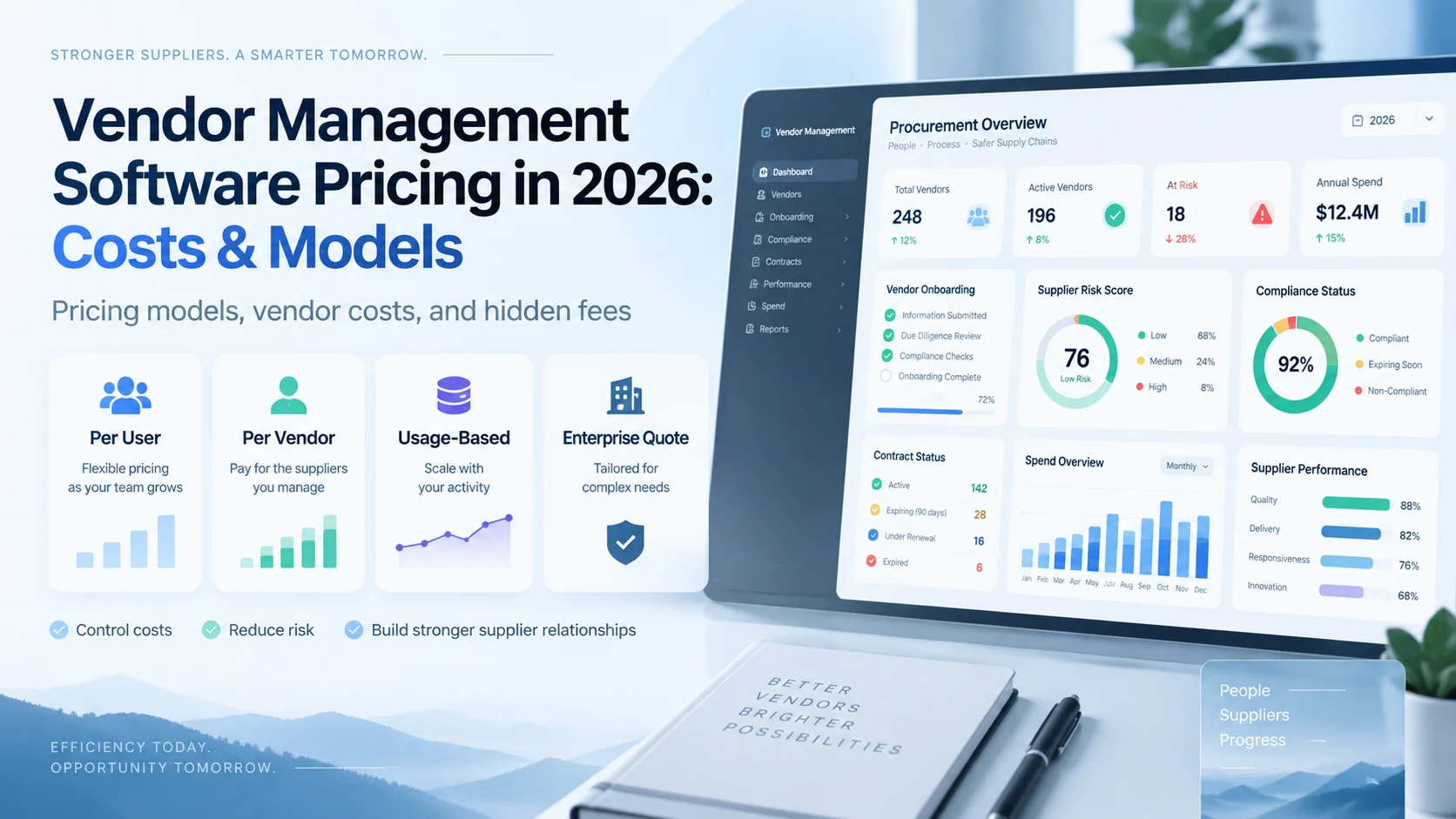
Pricing verified: August 20, 2026
Quick answer
Vendor management software pricing in 2026 ranges from roughly $99 per month for lightweight procurement/vendor workflows to $500-$2,000+ per month for broader mid-market procurement and supplier-management platforms, while enterprise vendor lifecycle, risk and source-to-pay suites are often custom-priced.
Current public examples include Tradogram Essentials at $99/month, Precoro Core from $499/month and Automation from $999/month billed annually, Zapro Spark at $699/month and Growth at $1,999/month, Tipalti Accounts Payable from $99/month with supplier onboarding, and SAP Ariba Supplier Lifecycle and Performance at a published $740/month product price. Gatekeeper, Procurify, Kissflow Procurement Cloud, Coupa and Kodiak Hub are primarily quote-led for buyer-side vendor management.
The real vendor management system price depends on what the platform actually manages: vendor records, onboarding, qualification, compliance documents, third-party risk, scorecards, contracts, sourcing, purchase orders, invoices, payments and spend analytics. Two tools can both call themselves vendor management software while solving very different parts of the supplier lifecycle.
Key takeaways
- Tradogram Essentials is currently $99/month, or $950.40/year on annual billing, and includes supplier management alongside purchasing and invoice workflows.
- Precoro Core starts at $499/month billed annually; Automation starts at $999/month; Enterprise is custom-priced.
- Zapro publishes vendor-management pricing at $699/month for Spark, $1,999/month for Growth and custom pricing for Scale.
- Tipalti Accounts Payable starts at $99/month with unlimited users and a self-service supplier portal, but transaction, payment, entity and module fees can increase total cost.
- SAP Ariba Supplier Lifecycle and Performance currently exposes a public $740/month product price, with contract terms from 3 to 60 months and auto-renewal.
- Gatekeeper is quote-led and currently meters plans mainly by third-party/vendor quota while keeping users unlimited.
- Procurify, Kissflow Procurement Cloud, Coupa and Kodiak Hub do not publish a simple buyer-side universal list price for the full vendor-management scope.
- Supplier portals can be free for suppliers even while the buying organization pays a large platform subscription. Do not confuse supplier-side fees with buyer-side software cost.
- Implementation, ERP/accounting integrations, risk data, sanctions/entity checks, SSO, API access and multi-entity requirements are common extra cost drivers.
- The term VMS is ambiguous: in staffing, a vendor management system can mean contingent-workforce software. This guide covers procurement/supplier vendor management, not staffing VMS.
Scope: procurement and supplier vendor management, not staffing VMS
Vendor management software is used in more than one market. Procurement and supply-chain teams use it to onboard, qualify, monitor and manage suppliers. HR and contingent-workforce teams also use the term vendor management system (VMS) for staffing agencies, contractors and external labor.
This guide is intentionally about procurement/supplier vendor management: supplier records, onboarding, compliance, risk, contracts, sourcing, performance, spend and supplier portals. It does not compare SAP Fieldglass, Beeline or other contingent-workforce VMS platforms.
How this differs from SaaS vendor management
CostLoop already has a SaaS Vendor Management guide for small and medium businesses. That article is a process framework for managing the software vendors your own company pays: ownership, cost, renewal dates, scorecards and subscription decisions.
This pricing guide solves a different search intent. It compares software bought by procurement, finance, operations and risk teams to manage suppliers and third parties at scale, including onboarding, compliance, sourcing, contracts and performance.
For the software-subscription process, see SaaS Vendor Management for Small and Medium Businesses.
Related CostLoop guides
- SaaS Vendor Management for Small and Medium Businesses
- Hidden Costs of SaaS
- Software Budget Template
- SaaS Cost Management
- Annual vs Monthly SaaS Billing
- How to Negotiate SaaS Pricing
- Renewal Tracker for Software Subscriptions
- What to Store With Every Software Subscription Record
- Software License Inventory
- CostLoop Features
- CostLoop Pricing
How vendor management software is priced in 2026
Vendor management software cost = base platform + vendor/user/transaction scale + supplier onboarding/risk checks + modules + integrations + implementation + support + renewal changes. Compare the same scope, not just the lowest starting price.
| Pricing model | How cost scales | Examples | Main risk |
|---|---|---|---|
| Flat / tiered monthly platform | Plan level, vendor cap and modules | Tradogram, Zapro | Feature gates or vendor-count cliffs |
| Procurement platform subscription | Workflow tier, users, entities and modules | Precoro, Tipalti | Buying a broader P2P suite than you need |
| Per-vendor / third-party quota | Active suppliers or third parties | Gatekeeper-style quota models | Growth in supplier base forces higher tier |
| Usage / transaction add-ons | Invoices, payments, checks, API or risk data | Tipalti, risk/verification add-ons | High operating volume raises variable cost |
| Custom enterprise quote | Users, suppliers, entities, modules, risk, integrations and services | Coupa, Procurify, Kissflow, Kodiak Hub | Opaque expansion and renewal economics |
Vendor management software pricing at a glance
| Platform | Current 2026 pricing signal | Pricing model | What drives cost |
|---|---|---|---|
| Tradogram | $99/mo Essentials; Premium & Scale custom | Tiered procurement plan | Users, modules, implementation, integrations |
| Precoro | $499/mo Core; $999/mo Automation; Enterprise custom | Tiered P2P platform | Users, entities, integrations, modules |
| Zapro | $699/mo Spark; $1,999/mo Growth; Scale custom | Vendor-count tiers | Vendor count, package, support |
| Tipalti | AP starts at $99/mo | Base subscription + transactions/modules | Payments, invoices, entities, modules, currencies |
| SAP Ariba Supplier Lifecycle & Performance | $740/mo published product price | Subscription product | Users, contract term, broader Ariba scope |
| Gatekeeper | Custom quote | Third-party quota + modules | Third-party count, modules, risk data, implementation |
| Procurify | Custom quote | Procurement platform | Pro licenses, modules, integrations, implementation |
| Kissflow Procurement Cloud | Custom / fixed annual agreement | Enterprise procurement platform | Scope, customization, services, adoption |
| Coupa | Custom buyer-side quote | Enterprise spend/supplier platform | Modules, entities, users, transaction scope, services |
| Kodiak Hub | Custom quote | Supplier relationship management | Supplier scope, integrations, analytics/risk modules |
Tradogram pricing
Tradogram is one of the clearest low-cost procurement/vendor-management options because it publishes a self-service entry price. Essentials is $99/month on monthly billing. Annual billing is discounted by 20%, bringing the current annual price to $950.40.
Essentials includes supplier management alongside purchase orders, AP invoices, payments, expenses and core purchasing workflows. Advanced procurement functions such as requisitions, sourcing RFx, receiving, real-time budget tracking, contract management, custom approvals and multi-entity controls can be add-ons or included in higher plans.
| Tradogram plan | Current price | User signal | Vendor-management relevance |
|---|---|---|---|
| Essentials | $99/mo or $950.40/yr | 1+ users; additional-user fee applies | Supplier management + core purchasing |
| Premium | Custom quote | 20+ users | Broader procurement, sourcing, contracts, approvals |
| Scale | Custom quote | Unlimited users | Larger, more complex organizations |
Precoro pricing
Precoro currently publishes Core starting at $499/month billed annually and Automation starting at $999/month. Enterprise is custom-priced. Vendor management is included inside the broader procure-to-pay workflow rather than sold as a narrow vendor register.
Core includes vendor management, contract repository, purchasing, approvals, expenses and accounting integrations. Automation adds more AI-driven and scalable procure-to-pay capabilities. Enterprise offers unlimited users and broader controls.
| Precoro plan | Monthly starting price | Annualized starting cost |
|---|---|---|
| Core | $499 | $5,988 |
| Automation | $999 | $11,988 |
| Enterprise | Custom | Custom |
Precoro can be excellent value if you also need purchasing, approvals and AP workflows. If your only problem is maintaining vendor records and compliance documents, compare it against a narrower vendor-management system before paying for a full P2P platform.
Zapro pricing
Zapro publishes vendor-management pricing directly: Spark is $699/month for up to 50 vendors, Growth is $1,999/month for up to 500 vendors, and Scale is custom for larger organizations. Both published tiers include unlimited users.
This is a useful example of quota-based vendor management pricing: adding employees does not necessarily raise the subscription, but growing the supplier base can move the organization into a more expensive tier.
| Zapro plan | Monthly price | Vendor capacity | Annualized cost |
|---|---|---|---|
| Spark | $699 | Up to 50 vendors | $8,388 |
| Growth | $1,999 | Up to 500 vendors | $23,988 |
| Scale | Custom | Large/custom scope | Custom |
Tipalti pricing: supplier onboarding inside AP and payments
Tipalti is not a pure supplier-performance platform, but it is relevant when vendor management means supplier onboarding, payment data, tax/compliance collection and global payables. Tipalti Accounts Payable currently starts at $99/month and includes unlimited users plus a self-service supplier portal.
The base price is only the start. Tipalti says transaction pricing applies per invoice and payment, and total cost also depends on payment volume, legal entities, enabled modules, global payment methods and currencies. Procurement, Expenses and Treasury can be added as additional modules.
Choose Tipalti when supplier onboarding and paying vendors are core requirements. If your main need is supplier scorecards, operational performance and third-party risk, a dedicated vendor-management or SRM platform may fit better.
SAP Ariba Supplier Lifecycle and Performance pricing
SAP currently exposes a public price signal for SAP Ariba Supplier Lifecycle and Performance: $740 per month, sold in blocks of one user, with contract durations from 3 to 60 months and auto-renewal on the current product page.
That number should not be treated as the total price of an SAP Ariba transformation. Organizations may also buy sourcing, procurement, business-network, risk and integration capabilities. Implementation, ERP connectivity, data migration and operating model complexity can materially increase TCO.
SAP Business Network also has supplier-side subscription and transaction economics. Those supplier charges are not the same thing as the buyer organization's subscription to Supplier Lifecycle and Performance.
Gatekeeper pricing: quota-based and quote-led
Gatekeeper is a vendor/third-party and contract lifecycle platform with quote-based pricing. Its current pricing page shows Pro for up to 250 third parties, Enterprise for up to 750 and Enterprise Plus above 750, while users remain unlimited across plans.
The vendor relationship is broader than a simple supplier directory: Gatekeeper combines third-party records with contracts, risk assessments, spend, compliance evidence, workflows and optional vendor portals.
There is one pricing detail buyers should verify carefully: Gatekeeper currently has public pages that disagree on implementation. Its pricing-details page says implementation starts from 40% of Year 1 subscription, while a vendor-management page says implementation is priced at 20% of first-year subscription. Because those are both official pages and conflict, the exact implementation fee should be confirmed in the current order form rather than copied from either page as universal fact.
Gatekeeper terms state that exceeding plan quotas can trigger an automatic upgrade after notice if the configuration is not reduced. Vendor-count growth therefore matters even though internal users are unlimited.
Procurify pricing: custom quote with role-based licenses
Procurify currently routes buyers through a sales/demo process rather than publishing one standard dollar rate. Its vendor management system is part of a broader procurement, AP and spend-control platform.
Current Procurify licensing documentation distinguishes Basic and Pro licenses. Basic licenses are free in most pricing plans and are intended for request-level users, while Pro licenses are consumed by users with approval, vendor, contract, AP, reporting or administrative permissions. That structure can reduce cost when many employees only submit requests.
Kissflow Procurement Cloud pricing
Kissflow Procurement Cloud is quote-led. Its supplier-management scope includes onboarding, vendor master data, contracts, catalogs, scorecards, due diligence and performance tracking, but the company currently sells the procurement platform through fixed annual agreements rather than a simple public per-user rate.
Kissflow states that AI and API usage do not carry surprise surcharges in its current pricing approach, while additional services such as hands-on implementation, customization, training and ongoing optimization can be purchased separately.
Coupa pricing: enterprise scope, buyer quote required
Coupa is a broad enterprise spend-management platform with supplier, sourcing, risk, procurement and payment capabilities. The buyer-side platform is generally quote-led rather than sold from one public vendor-management price card.
Do not confuse buyer pricing with supplier portal pricing. Coupa says suppliers can use the standard Coupa Supplier Portal without a fee, while optional supplier subscriptions such as Verified or Advanced have separate supplier-side prices. Those are not what a buying organization pays for Coupa procurement or supplier management.
Kodiak Hub pricing
Kodiak Hub is a supplier relationship management platform focused on supplier data, performance, risk, ESG, quality and analytics. The current product pages are demo/quote-led rather than publishing one self-service list price.
Its pricing therefore needs to be evaluated around the supplier population, data sources, ERP integrations, scorecards, risk feeds and modules included in the proposal.
What actually drives vendor management software cost?
1. Active vendor count. Some systems meter on active vendors, suppliers or third parties. Archived records may be free while live records count against the quota.
2. Internal user roles. Some platforms use unlimited users, while others distinguish requesters, approvers, admins, procurement users and finance users.
3. Supplier onboarding volume. Questionnaires, document collection, tax forms, banking validation and repeated onboarding can create implementation or transaction cost.
4. Third-party risk and screening. Credit data, sanctions checks, cyber ratings, entity verification and continuous monitoring are often metered separately.
5. Procurement modules. Sourcing, requisitions, purchase orders, invoicing, payments and spend analytics can turn a vendor-management tool into a larger P2P platform.
6. Contracts and renewals. Contract repository, CLM workflows, eSignature, obligations and renewal automation may be included, tier-gated or sold as modules.
7. Multi-entity complexity. Subsidiaries, cost centers, legal entities, currencies and regional workflows increase setup and operating complexity.
8. Integrations and API. ERP, accounting, identity, risk data and payment integrations can require higher tiers, connectors or professional services.
9. Implementation and migration. Cleaning vendor master data, importing contracts, mapping classifications and configuring workflows can be a major Year 1 cost.
10. Support and governance. Dedicated success managers, SLAs, SSO/SCIM, audit requirements and custom workflows usually push the deal upward.
Public-price annual cost comparison
For the vendors that publish enough information to calculate a simple starting annual cost, the spread is already large before implementation and add-ons.
| Product / plan | Monthly signal | Simple annualized cost | Important caveat |
|---|---|---|---|
| Tradogram Essentials | $99 | $1,188 monthly-billing equivalent / $950.40 annual plan | Additional users/modules may apply |
| Tipalti AP starting plan | $99 | $1,188 base | Transaction, payment, entity and module fees extra |
| Precoro Core | $499 | $5,988 | Billed annually |
| Zapro Spark | $699 | $8,388 | Up to 50 vendors |
| SAP Ariba Supplier Lifecycle & Performance | $740 | $8,880 | Specific SAP product; broader Ariba scope can cost more |
| Precoro Automation | $999 | $11,988 | Billed annually |
| Zapro Growth | $1,999 | $23,988 | Up to 500 vendors |
Why the cheapest plan can be the wrong comparison
A $99/month procurement tool and a quote-led third-party risk platform are not substitutes just because both store vendor records. The cheaper tool may be excellent for purchase orders and supplier records but weak on continuous cyber-risk monitoring. The enterprise tool may be overkill if the business only needs onboarding, contract visibility and simple scorecards.
Before comparing price, define the vendor lifecycle stages you actually need: request/intake, qualification, onboarding, due diligence, contract, purchasing, payment, performance, risk monitoring, renewal and offboarding.
Vendor management software for small businesses
Small teams should resist buying enterprise supplier-management suites simply because the demo looks comprehensive. If you manage tens rather than thousands of suppliers, focus on the specific workflow that is breaking today.
- Need supplier records + POs + invoices: Tradogram or Precoro-style procurement platforms may be enough.
- Need supplier onboarding + AP + global payments: Tipalti may fit better.
- Need contracts + third-party risk + performance: Gatekeeper-style VCLM platforms are a different category.
- Need enterprise supplier master, sourcing and global source-to-pay: SAP Ariba, Coupa, Procurify or Kissflow may justify a broader implementation.
Implementation costs
Implementation is one of the biggest reasons vendor management system pricing looks cheap on a website and expensive in a proposal. Supplier data is rarely clean enough to import without work, and organizations often have inconsistent naming, duplicate vendors, outdated contacts, missing tax IDs and contracts stored in multiple locations.
- Vendor master cleanup and deduplication
- Supplier category/taxonomy design
- Onboarding questionnaires and approval workflows
- Risk/compliance requirements by vendor type
- Contract and document migration
- ERP/accounting/payment integrations
- SSO and user provisioning
- Supplier portal branding and setup
- Scorecards and performance metrics
- Training, pilot and supplier communication
Hidden fees and overlooked costs
- Implementation and onboarding
- Additional internal users or Pro licenses
- Active vendor / third-party overages
- Risk, credit, cyber or sanctions data
- Entity verification and tax-ID checks
- ERP/accounting connectors
- API access
- SSO / SCIM
- Multi-entity or regional modules
- Contract management / eSignature
- Supplier portal or branded portal
- Sourcing / RFx
- AP / invoice automation
- Payment transaction fees
- Professional services and customization
- Premium support or SLA
- Renewal uplift and quota-driven upgrades
For the broader SaaS pattern, see Hidden Costs of SaaS.
Three-year total cost of ownership
The retired-tool term matters. A vendor-management platform may replace spreadsheets, contract trackers, risk questionnaires, standalone sourcing tools or AP onboarding workflows. But only count a saving if the old tool or manual process will actually be retired.
3-year TCO =
recurring subscription + vendor/user growth
+ transaction/risk fees + implementation
+ integrations + services + support
+ renewal increases - retired-tool savings
How to normalize vendor management quotes
- Use the same number of active vendors and expected three-year growth.
- Use the same internal-user and role assumptions.
- Match the same onboarding questionnaires, approvals and supplier portal scope.
- Include the same third-party risk, sanctions, cyber and financial monitoring.
- Match contract-management, sourcing, PO, invoice and payment requirements.
- Use the same legal-entity, country and currency assumptions.
- Price the same ERP/accounting/SSO/API integrations.
- Separate one-time implementation from recurring software.
- Ask how quota overages are handled mid-term.
- Calculate Year 1 and 36-month TCO including renewal uplift.
Vendor management vs procurement software
Vendor management owns the vendor relationship: master data, onboarding, compliance, performance, risk, contracts and governance. Procurement software owns the buying process: requests, approvals, purchase orders, receiving, invoices and spend controls.
Many modern platforms combine both. That is convenient, but it makes pricing comparisons harder. A company that only needs supplier governance should not automatically compare itself with a full procure-to-pay implementation.
Vendor management vs contract management
Contract management is one layer of vendor management, not the entire vendor lifecycle. A contract platform may manage drafting, approvals, signatures, obligations and renewals beautifully while providing little supplier onboarding or performance management.
Conversely, a procurement platform can manage suppliers and POs but still require a separate CLM product for sophisticated negotiation and legal workflows. Make the boundary explicit before buying.
Annual vs monthly billing
This category is heavily annual. Precoro publishes prices billed annually. Gatekeeper says annual commitment is its default. Enterprise vendor-management platforms usually price implementation and subscription together around an annual or multi-year commercial agreement.
Tradogram is useful as a transparent contrast because it publishes both monthly pricing and a 20% annual discount. The annual saving is real only if you are confident in vendor fit and workflow adoption.
For the general framework, see Annual vs Monthly SaaS Billing.
Negotiating vendor management software pricing
- Ask the vendor to separate base platform, vendor quota, modules, data/risk fees and implementation.
- Request expansion pricing for the next vendor/user/entity tier before signing.
- Negotiate migration and vendor-master cleanup into the implementation SOW.
- Ask whether suppliers ever pay fees to transact or maintain profiles.
- Get risk/check pricing in writing: per check, per supplier, per year or bundled.
- Ask what happens when active vendor count temporarily exceeds the plan quota.
- Negotiate renewal-uplift caps and multi-year price protection.
- Avoid purchasing a full P2P suite if supplier governance is the only urgent problem.
For tactics, see How to Negotiate SaaS Pricing.
What to store with a vendor-management software subscription
- Vendor-management platform and plan
- Active vendor / third-party quota
- Internal paid-user or role limits
- Modules included
- Risk/check allowances
- Entities/countries covered
- Integration list
- Implementation/SOW value
- Annual contract value
- Contract term and renewal date
- Notice period
- Renewal-uplift cap
- Support/SLA level
- Order form, SOW, invoices and pricing exhibit
- Business owner and procurement/finance owner
For the general structure, see What to Store With Every Software Subscription Record. For license and role hygiene, see Software License Inventory. For the wider budgeting process, see Software Budget Template and SaaS Cost Management. Start renewal review before the term locks in using CostLoop's Renewal Tracker.
Frequently asked questions
How much does vendor management software cost in 2026?
Transparent entry products can start around $99/month, while broader mid-market procurement/vendor platforms commonly start around $499-$2,000+ per month. Enterprise supplier-management, risk and source-to-pay platforms are often custom-priced and can add implementation, integrations and risk-data costs.
What is vendor management system pricing based on?
Common pricing variables include active vendors, internal users or roles, procurement modules, transaction volume, entities, risk/check usage, integrations, implementation and support.
How much does Tradogram cost?
Tradogram Essentials is currently $99/month. Annual billing is discounted 20% to $950.40/year. Premium and Scale use custom pricing.
How much does Precoro cost?
Precoro Core currently starts at $499/month billed annually, Automation at $999/month, and Enterprise is custom-priced.
How much does Gatekeeper cost?
Gatekeeper currently uses custom pricing based on scope, third-party quota and modules. Its current plan structure includes Pro up to 250 third parties, Enterprise up to 750 and Enterprise Plus above 750, with unlimited users.
How much does SAP Ariba Supplier Lifecycle and Performance cost?
SAP currently publishes a $740/month price for the Supplier Lifecycle and Performance product page, sold in blocks of one user with contract terms from 3 to 60 months. Broader SAP Ariba deployments can include additional products and services.
How much does Tipalti cost?
Tipalti Accounts Payable currently starts at $99/month with unlimited users and a self-service supplier portal. Transaction, payment, entity and additional-module fees can increase total cost.
Is Coupa Supplier Portal free?
Coupa says the standard Supplier Portal is free for suppliers. That does not mean the buyer-side Coupa platform is free; buyer procurement and supplier-management pricing is a separate commercial quote.
What is the difference between vendor management software and staffing VMS?
Procurement vendor management software manages suppliers, onboarding, risk, contracts and performance. Staffing VMS software manages contingent labor, staffing agencies, timesheets and external-workforce spend. They are different software categories.
What hidden costs should I look for?
Check implementation, vendor/user overages, risk/verification data, ERP integrations, API/SSO, contract modules, sourcing, AP/payments, professional services, support and renewal uplift.
Final verdict
Vendor management software pricing in 2026 is fragmented because the category spans lightweight supplier records, procurement workflows, third-party risk, contract lifecycle, AP onboarding and enterprise source-to-pay.
For smaller teams, transparent platforms such as Tradogram, Precoro and Zapro give useful public cost anchors. Tipalti is relevant when supplier onboarding and payment are central. Gatekeeper fits contract/risk/performance-heavy vendor governance. SAP Ariba, Coupa, Procurify, Kissflow and Kodiak Hub require more structured quote evaluation.
The correct buying question is not "what is the cheapest VMS?" It is "which vendor-lifecycle stages do we actually need, how will the price scale as vendors and entities grow, and what is the three-year cost after implementation, integrations and risk data?"

About the author
Milosh Mladenovski is a CostLoop founder and works on subscription discovery, license inventory and recurring software cost workflows. Author profile · LinkedIn